A Tactical Cabinet Guide: The Difference Between Stock, Semi-Custom, and Custom Cabinets
Stock, semi-custom, and custom cabinets differ mainly in how much flexibility you get on sizes, finishes, construction options, lead time, and price. If you are planning a kitchen, bath, laundry room, or built-in storage project, that difference matters more than the label itself. The right choice depends on how exact your layout needs to be, how much you want to spend, and how much design control you actually need.

Call for a free estimate:
Many cabinet quotes sound clearer than they are. A showroom may use the same door style across all three categories, which makes the products look similar even when the construction and ordering rules are very different. The practical way to compare them is to look at four things in writing: available sizes, modification limits, finish options, and delivery timeline.
According to the Kitchen Cabinet Manufacturers Association, cabinet lines are commonly grouped by stock, semi-custom, and custom manufacturing approaches, with increasing flexibility as you move up the ladder. That broad framework is useful, but it does not tell you whether paying more will solve your specific layout problem. In many projects, it will. In others, fillers, panels, and better planning can do the job for less.
What is the difference between stock, semi-custom, and custom cabinets?
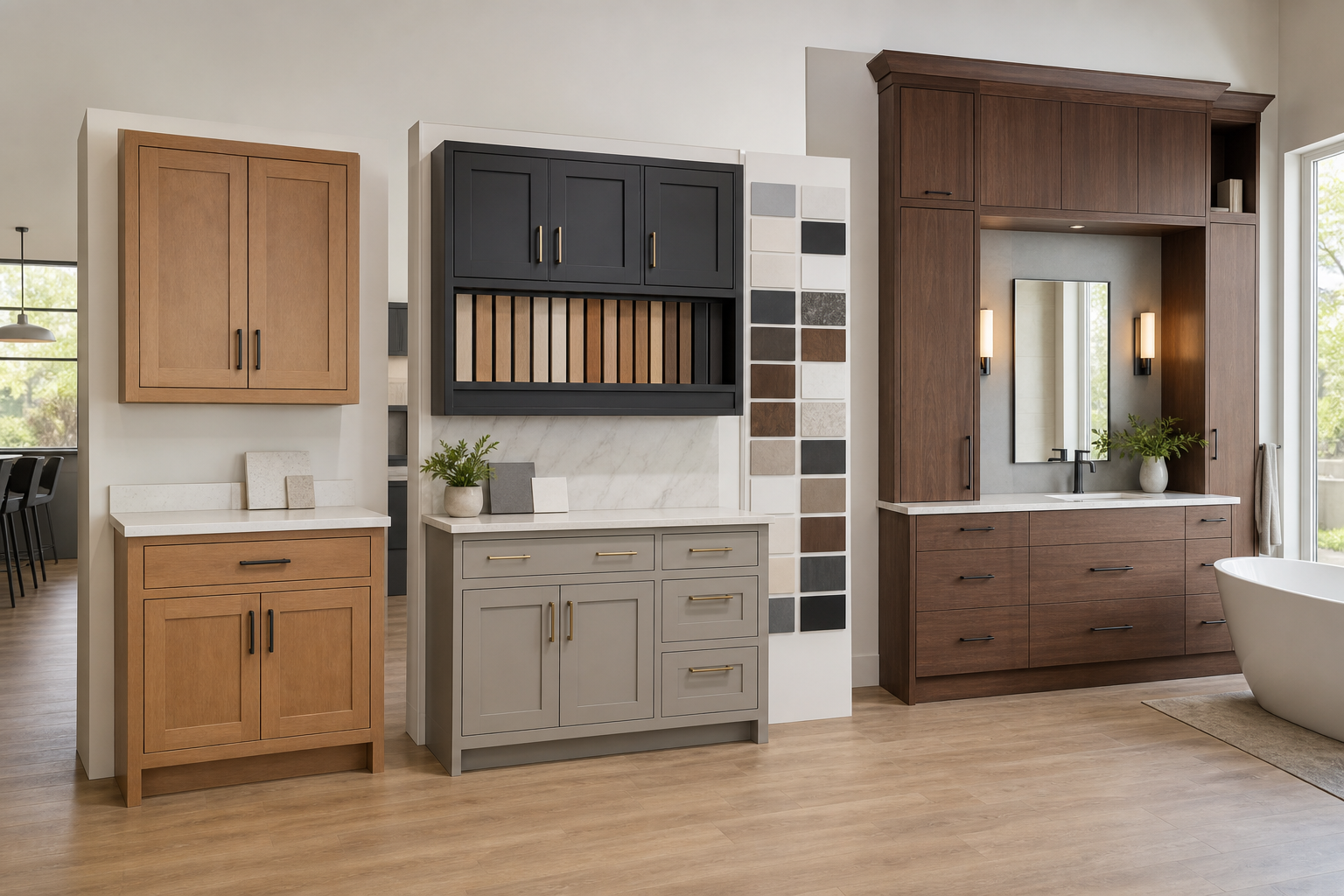
The core difference is the amount of choice built into the product before it is ordered. Stock cabinets come in fixed sizes and a limited menu of styles and finishes. Semi-custom cabinets start from standard cabinet boxes but allow a wider range of dimensions, accessories, and finish selections. Custom cabinets are built to order with the fewest preset limitations.
That does not automatically make custom the best option. A simple, standard-size room can work very well with stock or semi-custom cabinets if the line offers the storage features you want. Custom becomes more useful when the room has unusual dimensions, obstacles, or a design goal that standard sizing cannot handle cleanly.
How do stock cabinets work?
These cabinets are made in predetermined sizes and configurations, then sold with limited changes. You usually choose from a set list of widths, heights, depths, door styles, and finishes. Some lines are stocked locally for fast pickup, while others are ordered from a factory but still follow fixed sizing rules.
According to the American National Standards Institute , cabinet construction is evaluated by performance criteria such as load, durability, and finish testing rather than by whether a cabinet is labeled stock or custom. In plain terms, a stock cabinet can still be well made if it meets the line’s construction and testing standards. The category describes flexibility, not guaranteed quality.
Stock cabinets usually make the most sense when your layout is straightforward and timing matters. A hall bath vanity, a laundry room, or a basic kitchen footprint often fits standard sizes without much waste. If the plan needs only common widths and standard appliance spacing, stock can be the efficient buy.
Where stock cabinets fit best
Simple room geometry is where this category earns its keep. Straight runs, common corner layouts, and projects where you are replacing cabinets without moving walls often adapt well to fixed-size boxes. You may still need fillers or trim pieces, but that is normal and not a sign of poor planning.
Where stock cabinets fall short
Tight dimensions expose the limits quickly. If you need an odd width to center a sink under a window, want a specific inset around an appliance, or need storage built around a soffit or sloped ceiling, stock lines may force compromises that are visible every day.
How do semi-custom cabinets work?
This category gives you a wider menu of factory options without going fully made-to-order. Semi-custom lines usually offer more widths and heights than stock, plus upgrades such as deeper drawers, organizer inserts, glass doors, specialty moldings, and broader finish selections.
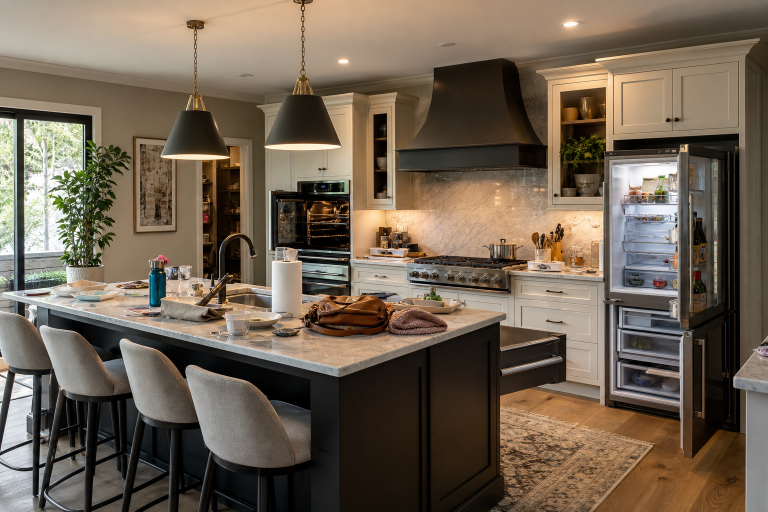
According to the National Kitchen and Bath Association planning guidelines, good kitchen design depends on clearances, workflow, and functional storage planning rather than on a single product tier. Semi-custom often hits the middle ground because it gives a designer more room to solve spacing and storage issues without the cost and lead time of full custom work.
For many homeowners, this is the practical sweet spot. You get more control over the final fit and look, but you still order from a defined catalog. That usually means fewer surprises than a one-off build and more flexibility than a rigid stock line.
What usually changes in semi-custom
The most common upgrades are modest size adjustments, expanded finish choices, construction upgrades, and accessory options. Depending on the line, you may be able to adjust depth, request furniture-style details, choose upgraded drawer hardware, or specify interior storage features that stock lines do not offer.
What semi-custom still may not do
Factory modification menus still have limits. A line may allow some width changes but not unusual heights. It may offer paint colors from a set palette but not a fully matched custom color. If your room needs exact built-in proportions, the catalog can still run out of answers.
What makes custom cabinets different?
Full custom cabinetry is built around your space and design rather than around a preset catalog. Sizes can be made to fit unusual dimensions, and details such as wood species, joinery style, finish, interior configuration, and trim treatment are typically more open-ended.
That flexibility is useful when the room itself is the problem. Older homes often have walls that are out of square, nonstandard ceiling heights, or architectural features that make standard boxes look pieced together. Custom work can also make sense when you want a furniture look, inset construction, or a species and finish combination not offered in factory lines.
Custom is also where quote clarity matters most. Because the product is less standardized, proposals can vary widely in what they include. One quote may include site measuring, shop drawings, finish samples, installation fillers, and touch-up materials. Another may price only the boxes and doors. If those details are vague, comparing bids by total price alone is not useful.
How much do stock, semi-custom, and custom cabinets cost?
For a typical kitchen, cabinets often account for a large share of the remodel budget, and the range rises sharply from stock to custom. Based on the 2024 Cost vs. Value Report from Remodeling magazine, a midrange major kitchen remodel nationally averages tens of thousands of dollars, with cabinetry representing a primary cost component in most project breakdowns. For product-only shopping, published retail and manufacturer dealer pricing varies by line, but homeowners commonly see stock cabinets at the low end, semi-custom in the middle, and custom at the top with no meaningful universal per-linear-foot rule that fits every quote.
That is why a broad price ladder is more honest than a fake precise figure. Expect stock to be the least expensive option, semi-custom to cost noticeably more because of added choices and factory modifications, and custom to cost the most because design, materials, labor, and finish work are less standardized. The exact spread depends most on door style, finish type, wood species, construction upgrades, and installation complexity.
Call for a free estimate:
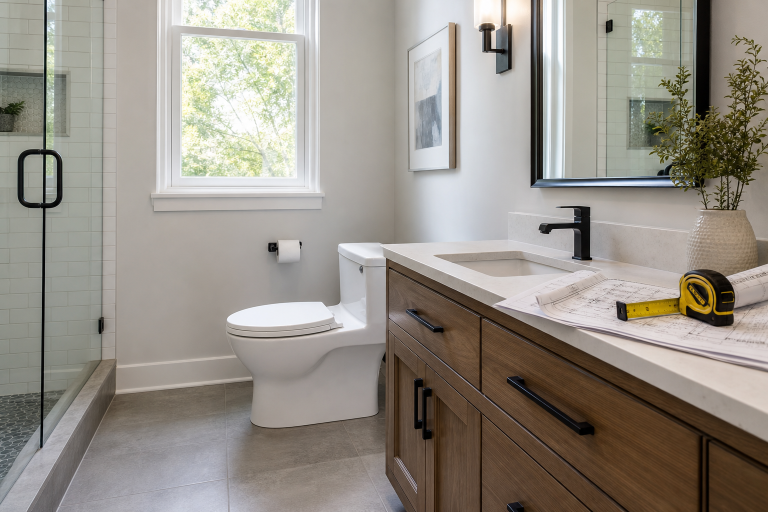
If you are budgeting a bath rather than a full kitchen, the same order usually holds. A standard vanity from a stock line is often enough. A semi-custom vanity can be worth the extra cost when you need better drawer storage or a better fit between walls. Custom becomes easier to justify when the room has awkward dimensions or when you are matching existing millwork.
Which cabinet type gives you the best value?
The best value usually comes from the least expensive category that fully solves the layout and storage problem. If a stock line fits the room cleanly and offers the drawer bases, organizers, and finish you want, paying for custom work may add little beyond bragging rights. If stock leaves large fillers, poor appliance alignment, or wasted corners, moving up to semi-custom can be the smarter buy.
Custom tends to deliver the strongest value only in specific situations: unusual room dimensions, high-visibility built-ins, exact style matching, or a design that depends on precise proportions. Outside those cases, semi-custom often gets close enough that the extra jump to custom is hard to defend.
How should you compare cabinet quotes?
The most reliable comparison is a written scope that shows exactly what is included in each line. Without that, one bid can look cheaper simply because key items were left out.
- Cabinet line and category: stock, semi-custom, or custom
- Box material and drawer box material
- Door style and finish specification
- Available modifications and any upcharges
- Soft-close hinges and drawer glides, if included
- Interior accessories such as pull-outs, tray dividers, or waste storage
- Panels, fillers, toe-kick, crown, and light rail details
- Delivery timeline and whether lead time is estimated or confirmed
- Installation scope, including removal, scribing, and touch-up
- Warranty terms from the manufacturer or cabinet shop
Published warranty language is worth reading before you sign. As explained in Abodence’s roof warranty terms guide, homeowners often focus on the headline promise and miss the exclusions and workmanship boundaries. Cabinet warranties can have the same problem, especially around finish variation, humidity-related movement, and installer-caused issues.
What construction details matter more than the label?
The category tells you how flexible the order can be. It does not tell you whether the cabinet itself is built the way you want. Construction details are where quality differences show up.
Box and back construction
Thicker box material, a solid attachment method, and a sturdy back panel generally matter more than whether the cabinet is called stock or semi-custom. Manufacturer specification sheets are the right place to verify this. Look for the actual material and thickness rather than sales shorthand such as “all wood,” which can mean several different things.
Drawer hardware and joinery
Full-extension drawer glides, soft-close hardware, and durable drawer box joinery affect daily use more than a long menu of finish colors. A modest cabinet line with better drawers can be a better buy than a fancier-looking line with weaker hardware.
Finish system
Factory finishes are usually more controlled and repeatable than field-applied finishes because they are produced under consistent conditions. Custom shop finishes can still be excellent, but the quote should specify the finish system and sample approval process so you know what standard is being promised.
When should you choose stock, semi-custom, or custom cabinets?
The right choice depends on the room, not on status. Match the category to the problem you are trying to solve.
- Choose stock when the layout is standard, the budget is tight, and the available sizes fit without large compromises.
- Choose semi-custom when you want better sizing options, more storage features, or a more tailored look without moving to a full one-off product.
- Choose custom when the room has unusual dimensions, the design requires exact proportions, or you need details a catalog line does not offer.
If you are remodeling a bathroom, storage planning matters as much as cabinet category. Abodence’s comfort-height fixtures guide is a useful companion if you are balancing vanity size, clearances, and fixture choices at the same time.
What mistakes do homeowners make when choosing cabinets?
A common mistake is paying for flexibility they do not need, or skipping flexibility they do need. Both errors come from shopping by display appearance instead of by room requirements.
Another common problem is treating all “upgrades” as equal. A paint upgrade, a plywood box upgrade, and a drawer organizer package do not have the same value. Some improve daily function. Some are mostly visual. Some matter only if the room has a specific layout challenge.
Lead times also get misunderstood. A faster cabinet line is not automatically better if it creates visible layout compromises. At the same time, waiting for custom work is hard to justify if a semi-custom line can solve the same problem with standard modifications.
FAQ
Are custom cabinets always better quality?
Quality depends on materials, hardware, construction, and finish standards, not on the category name alone. A well-specified stock or semi-custom line can outperform poorly specified custom work.
Do semi-custom cabinets cost a lot more than stock?
The jump is usually noticeable, but the exact increase depends on the line and the options selected. Modest upgrades may keep the gap reasonable, while specialty finishes and accessories can push the price much higher.
Can stock cabinets look high-end?
Good design choices can make stock cabinets look far more expensive than their category suggests. Door style, hardware, panels, trim details, and a layout that fits the room well all affect the final result.
Are custom cabinets worth it in a small bathroom?
Small bathrooms justify custom work mainly when the dimensions are awkward or storage needs are very specific. In a standard-size bath, a stock or semi-custom vanity is often enough.
Call for a free estimate:
How long do cabinet orders usually take?
Lead time varies by manufacturer, dealer process, finish, and season, so the only reliable answer is the written timeline for the exact line you are considering. Stock is usually fastest, semi-custom is typically next, and custom often takes the longest.
If you are weighing cabinet options and the quotes are hard to compare, getting one more written proposal with a fully itemized scope is often the clearest next step. Please call a listed specialist for a free, no-obligation discussion.
Sources: Kitchen Cabinet Manufacturers Association, American National Standards Institute A161.1, National Kitchen and Bath Association, Remodeling magazine Cost vs. Value Report 2024