Quartz vs Granite Countertops: Performance, Cost, and Care Differences that Matter.
Quartz countertops are often the easier low-maintenance choice, while granite can be the better fit if you want a natural stone look and are comfortable with periodic sealing.

Call for a free estimate:
That basic split explains most of the real-world decision. Both materials are common premium countertop options. Both can perform well for years when they are selected for the right use and installed correctly. The differences that matter are how each surface is made, how they handle stains and heat, what ongoing care they need, and what you can expect to pay.
If you are planning a kitchen remodel, the countertop decision also affects layout, sink details, edge profiles, and backsplash choices. For broader planning issues, Abodence has also covered kitchen layout mistakes to avoid and remodel quote questions that help control scope and cost.
What is the real difference between quartz countertops and granite?
One is an engineered surface and the other is a natural stone slab. According to the Natural Stone Institute, granite is a natural stone cut from quarried blocks, while quartz surfacing is a manufactured product made from quartz and binding agents.
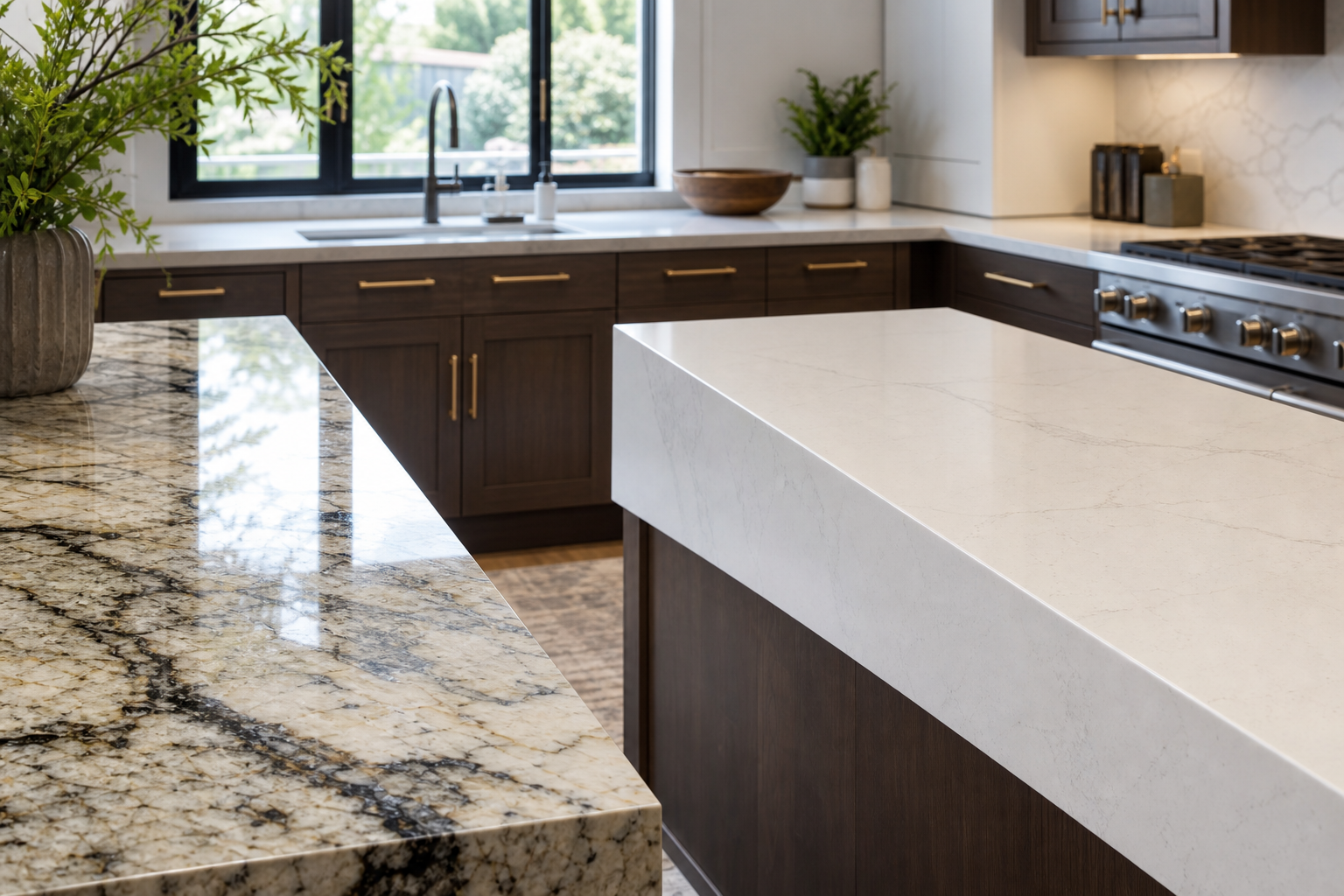
That difference shapes nearly everything else. Granite slabs have natural variation in color, veining, and pattern. No two slabs are identical. Quartz designs are more controlled from slab to slab, which can make matching a large kitchen easier. If you want a consistent look across long runs, waterfall ends, or multiple pieces, quartz usually gives you more predictability.
Granite also tends to appeal to buyers who want a one-of-a-kind natural material. Quartz appeals to buyers who want a cleaner, more uniform appearance or a pattern designed to resemble marble without the same maintenance profile.
How do quartz countertops and granite perform in daily kitchen use?
Most households will find both materials durable enough for normal cooking, cleanup, and everyday wear, but they do not respond the same way to stains, scratches, and heat.
Which surface handles staining better?
Quartz generally has better stain resistence because the surface is nonporous. The Marble Institute of America describes natural stone as a material that can absorb liquids if left unprotected, which is why sealing matters for many granite installations.
In practical terms, a wiped-up spill is rarely a major issue on either surface. The difference shows up when oil, wine, coffee, or strongly colored food sits longer than it should. A properly sealed granite top can perform well, but that protection depends on the condition of the sealer. Quartz does not rely on a separate sealer for routine stain resistance.
Which one resists scratches better?
Both are considered hard surfaces for kitchen use, and both manufacturers and stone trade groups advise using cutting boards rather than cutting directly on the countertop. Caesarstone care guidance states that quartz surfaces are highly scratch resistant but should still not be used as a cutting surface. The same practical advice applies to granite. A knife can dull quickly against either material, and edge damage is still possible with hard impact.
Which one handles heat better?
Granite is usually the safer choice around heat exposure from hot cookware. MSI Surfaces care guidance for natural granite notes that granite is heat resistant in ordinary kitchen use, while quartz manufacturers such as Silestone and Caesarstone state that trivets or hot pads should be used and that sudden or sustained heat can damage the resin system in engineered quartz.
If you regularly move hot pans from the oven to the counter, granite has an advantage. If you already use hot pads consistently, that difference may not matter much in daily life.
What maintenance do quartz countertops and granite actually require?
Quartz usually needs less ongoing attention, while granite needs periodic sealing depending on the specific stone and how the countertop is used.
According to MSI Surfaces, some granite countertops need sealing at installation and periodic resealing afterward, with timing depending on the stone and use conditions. By contrast, quartz care documents from major manufacturers typically say sealing is not required.
How should you clean quartz countertops?
Mild soap and water or a manufacturer-approved cleaner is the standard approach. Caesarstone and Cambria both advise routine cleaning with non-abrasive products and caution against harsh chemicals that can affect the finish.
That makes quartz attractive if you want a simple care routine and do not want to track sealing schedules.
How should you clean granite countertops?
Stone-safe cleaners or mild soap and water are the usual recommendation, and the sealer condition matters over time. The Natural Stone Institute advises avoiding acidic or abrasive products that can affect some stone finishes and sealers.
Granite care is still straightforward. It just asks a little more from you over the long term.
How much do quartz countertops and granite cost in 2026?
In 2026, installed quartz and granite countertops commonly fall in the broad range of about $40 to $100 or more per square foot, depending on color, thickness, edge profile, cutouts, and regional labor. For a current market benchmark, Angi’s 2026 countertop cost guidance lists quartz at roughly $50 to $200 per square foot installed and granite at roughly $40 to $100 per square foot installed.
Those ranges are wide because countertop pricing is driven by the types of quartz and granite. Entry-level granite can cost less than premium quartz. Exotic granite can cost more than many quartz colors. Fabrication details also add up fast, especially if your kitchen includes an island, full-height backsplash, multiple sink cutouts, or mitered edges.
Call for a free estimate:
What usually changes the final quote?
Fabrication complexity is often the biggest swing factor after slab selection. A straightforward kitchen with a standard eased edge and one sink opening will usually price more cleanly than a design with curved shapes, waterfalls, or several seam-sensitive runs.
- Slab tier or color group
- Thickness, often 2 cm or 3 cm
- Edge profile complexity
- Number of sink and faucet cutouts
- Backsplash height and material match
- Island size and seam planning
- Regional labor and delivery conditions
Which countertop is better for resale and design flexibility?
Either material can support resale if the color, layout, and installation quality fit the home, but quartz often gives you more control over a clean, current look.
Design flexibility is where quartz has gained ground. Because patterns are manufactured, you can often choose from bright whites, soft concrete looks, bold veining, or more uniform neutrals with less surprise between the showroom sample and the installed slab. Granite gives you a natural look that many buyers still value, especially in homes where wood cabinetry, warmer palettes, or traditional styling are part of the overall design.
A very busy granite pattern can make a smaller kitchen feel visually crowded. On the other hand, a flat-looking quartz color can read a little sterile if the rest of the room lacks texture. The better choice depends on the cabinets, flooring, lighting, and how much visual variation you want in the room.
When is quartz the smarter choice?
A busy kitchen that needs simple upkeep is often better served by quartz.
Quartz usually makes sense when you want low maintenance, consistent patterning, and easier stain resistance without a sealing routine. It is also a practical fit if you are trying to coordinate several slabs across a large kitchen and want a more predictable result.
Choose quartz if these points match your priorities:
- You want a nonporous surface with no routine sealing
- You prefer a more consistent slab appearance
- You like marble-inspired looks but want easier care
- Your household is good about using trivets for hot cookware
- You want simpler day-to-day cleanup
When is granite the smarter choice?
Frequent cooking with hot pans and a strong preference for natural stone often point toward granite.
Granite is a better fit when you want the depth and variation of a quarried slab and do not mind periodic sealing. It can also be the more practical option if heat exposure is part of how your kitchen is actually used. For some projects, granite may price competitively with mid-range quartz, especially when you are selecting from common colors rather than exotic slabs.
Choose granite if these points match your priorities:
- You want a natural stone with unique movement and variation
- Heat resistance matters more than stain resistance
- You are comfortable resealing when needed
- You prefer a less uniform, more organic look
- You find a granite color group that fits your budget better than quartz
What mistakes should you avoid when comparing quotes?
The most useful quote is the one that makes the fabrication scope easy to verify.
Countertop quotes can look similar at the top line while including very different work. Ask each fabricator to identify the slab brand or stone name, thickness, finish, edge profile, number of cutouts, backsplash scope, seam locations if known, and whether removal and disposal of the old countertop are included. Warranty terms should also be spelled out in writing. Engineered quartz warranties come from the manufacturer and have care conditions. Natural stone warranty language may differ because much of the performance depends on the slab itself and the installer’s workmanship terms.
If you are comparing premium surfaces across a larger remodel, this is also where fixture heights, appliance clearances, and layout details start to matter. Abodence’s guide to comfort-height fixtures can help if your project includes adjacent bath or utility space decisions.
How should you decide between quartz countertops and granite?
The best choice comes down to whether you value lower maintenance or natural character more.
Pick quartz if you want the simpler care routine and a more controlled design result. Pick granite if you want a true natural stone and better tolerance for everyday heat exposure. Neither choice is automatically better, and the more expensive slab is not always the better buy. A mid-range color that fits your kitchen well and comes with a clear fabrication scope is often the smarter decision than stretching for a premium pattern you do not need.
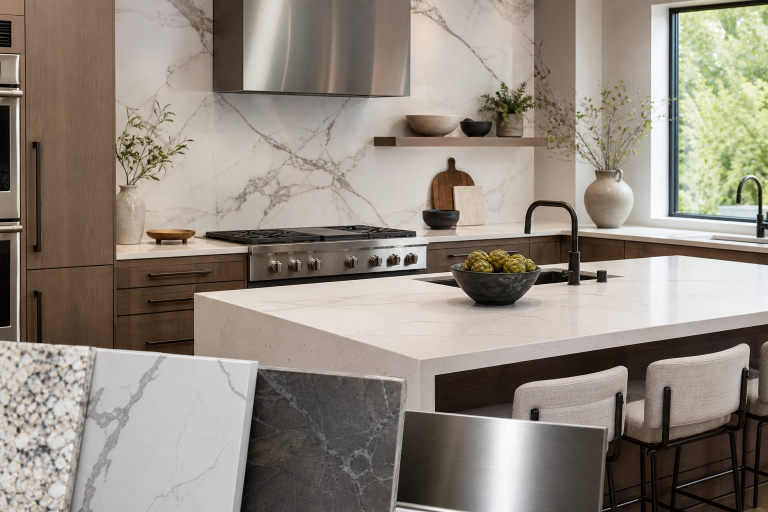
Bring home full-size samples when possible. View them next to your cabinet finish, flooring, and backsplash in daylight and at night. That step will usually tell you more than another hour of online comparison.
If you want help sorting countertop options as part of a larger remodel scope, please call one of the listed specialists for a free, no-obligation discussion.
Call for a free estimate:
Sources: Natural Stone Institute consumer care guidance, MSI Surfaces sealing guidance, Caesarstone care and maintenance guidance, Cambria care and maintenance guidance, Silestone care guidance, Angi 2026 countertop cost guidance