HVAC Repair or Replace: Smart Signs to Make the Right Call
Replacing or repairing an HVAC system is usually the right question when your system still runs, but comfort, reliability, or energy use has started to slip.

Call for a free estimate:
Most homeowners do not need a dramatic rule like “always replace after 10 years” or “always repair if it still turns on.” The better decision comes from a short list of facts: the system’s age, the cost of the current repair, the type of failure, refrigerant compatibility, efficiency level, warranty status, and whether the equipment is correctly sized for the house.
According to the U.S. Department of Energy, central air conditioners generally last 15-20 years with proper maintenance, and the same federal guidance says replacing an older unit with a newer high-efficiency model can reduce cooling energy use substantially in the right conditions. That does not mean replacement is automatically the better choice. A younger system with a single failed part often makes more sense to repair.
When does HVAC repair make more sense than replacement?
A repair usually makes sense when the system is relatively young, the fault is limited to one component, and the rest of the equipment is still performing normally.
Age matters first because it sets the context for every other decision. If your air conditioner or heat pump is well under the 15-20 year lifespan range the U.S. Department of Energy cites for central air, a repair is often the lower-risk choice, especially when the compressor and coil are intact and the equipment has not had repeated breakdowns.
Manufacturer warranty terms also matter. Trane’s published limited warranty documents and Carrier’s consumer warranty documentation both show that major parts coverage can reduce the financial case for replacement when a covered component fails. Labor is often separate, but a covered part can change a four-figure repair into a much smaller bill.
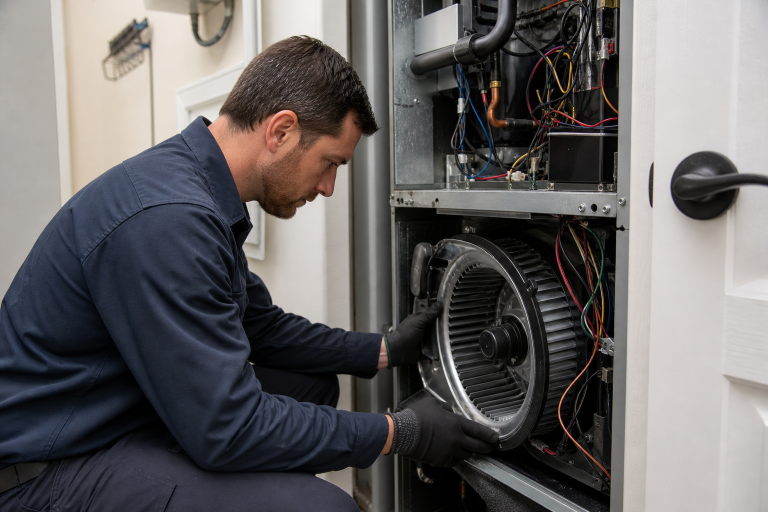
Repair is also the more sensible path when the problem is external to the core equipment. A failed thermostat, contactor, capacitor, blower motor, condensate pump, or control board can often be addressed without replacing the whole system. If you want background on one common example, Abodence has a guide to HVAC blower motor problems that explains how a single component issue can look bigger than it is.
When is replacing your HVAC system the smarter choice?
Replacement becomes the smarter choice when the equipment is old, the repair is expensive, or the current system cannot reasonably deliver the comfort and efficiency you need.
The Air-Conditioning, Heating, and Refrigeration Institute, through its consumer guidance on system matching and certified performance, emphasizes that HVAC equipment works best as a matched system rather than a random mix of old and new major components. In practice, that matters most when a compressor or coil fails on an aging unit. Replacing one major part inside a worn system can leave you with a costly repair and the next weak point still waiting.
Refrigerant type can also push the decision toward replacement. According to the U.S. Environmental Protection Agency, ozone-depleting refrigerants such as HCFC-22, commonly called R-22, are no longer produced or imported for new supply in the United States. If your older system uses R-22 and has a leak or major sealed-system failure, repair can become hard to justify because refrigerant availability and cost have changed sharply compared with newer equipment.
Replacement is also more reasonable when comfort problems are structural, not incidental. If some rooms never cool properly, humidity stays high, or the system runs for long stretches without keeping up, the issue may be sizing, duct design, or equipment mismatch rather than one broken part. In that situation, putting money into another repair may not solve the problem you actually have. Abodence covers this in more detail in its right-size HVAC unit guide.
How old is too old to keep repairing an HVAC system?
Once your equipment is approaching the upper end of the typical 15-20 year lifespan, each major repair deserves extra scrutiny.
Age by itself is not a failure. Some systems last longer with excellent maintenance and moderate use. Others age faster because of climate, installation quality, or heavy runtime. Still, the Department of Energy lifespan range is useful because it gives you a real benchmark instead of guesswork.
A system in the first half of its expected life often deserves repair unless the diagnosis reveals a major design or installation problem. A system near or beyond that range deserves a replacement quote whenever the repair involves the compressor, heat exchanger, evaporator coil, condenser coil, or a refrigerant leak in the sealed system.
For furnaces, the heat exchanger deserves special caution. The U.S. Consumer Product Safety Commission advises homeowners to have furnaces inspected and maintained regularly and to address furnace safety concerns promptly. If a contractor documents a failed heat exchanger and the furnace is older, replacement is often the practical path because that repair can be costly and safety-critical.
How much repair cost is too much before replacement makes sense?
A repair bill in the high hundreds may still be reasonable on a newer system, while a bill in the low thousands can be hard to justify on equipment near the end of its service life.
There is no universal government rule that says a specific dollar amount triggers replacement. The common “50 percent rule” is widely used in the trade as a rule of thumb, but it is not a formal code or federal standard. The more reliable way is to compare the current repair against three things: the age of the system, the likelihood of another major failure, and the installed cost of a full replacement in your market.
For replacement pricing context, the 2025 Angi central air conditioning installation cost guide lists a national range of roughly $3,900-$8,000 for central AC installation, while HomeAdvisor’s 2025 central AC cost guide lists a broadly similar range depending on size and project scope. Those are marketplace estimates rather than code or standards data, but they are useful as a rough comparison point when a contractor proposes a very large repair on aging equipment.
What should you compare in the quote?
The most useful comparison is not just price. It is scope, warranty, and what problem each option actually solves.
- Exact failed part or confirmed fault
- Total repair cost, with labor and any refrigerant clearly separated
- Whether the repair restores full function or only addresses the immediate symptom
- Replacement equipment efficiency rating and matched-system details
- Parts and labor warranty terms for both options
- Any duct, drain, electrical, or controls work included in the replacement scope
Call for a free estimate:
Which problems usually point to repair, and which point to replacement?
Smaller electrical or control failures often point to repair, while sealed-system failures and repeated major breakdowns more often point to replacement.
Problems that often support repair
Single-component failures on otherwise healthy equipment are commonly worth fixing. That includes thermostats, capacitors, relays, contactors, blower motors, inducer motors, igniters, and some control boards. Lennox consumer support literature and Goodman service documentation both distinguish these service parts from core equipment failures that can change the economics more dramatically.
Problems that often support replacement
Compressor failure, evaporator coil leaks, condenser coil leaks, repeated refrigerant loss, cracked heat exchangers, and multiple major repairs in a short period usually strengthen the case for replacement. Those faults either affect the most expensive parts of the system or suggest the equipment is wearing out in more than one place.
Repeated breakdowns deserve special weight because they change the issue from “Can this be fixed?” to “What are you buying by fixing it?” If the answer is one more season with no clear reliability outlook, a replacement estimate becomes worth serious consideration.
Can higher efficiency alone justify replacing an HVAC system?
Efficiency alone can justify replacement in some cases, but it is usually strongest as a tie-breaker rather than the only reason.
According to the ENERGY STAR, certified central air conditioners and heat pumps meet efficiency criteria set by the program, and replacing older equipment can reduce energy use when the new system is properly selected and installed. Savings vary by climate, existing equipment, thermostat settings, and duct performance.
If your current system is still reliable and the repair is minor, chasing efficiency alone may not produce the best financial outcome. If your system already needs a major repair, though, stepping into a higher-efficiency replacement can make more sense because you are comparing one large spend against another. For a plain-language explanation of what those ratings mean, Abodence also has a guide to SEER2 ratings.
Installation quality matters as much as the label. ACCA Manual J and Manual S guidance, which contractors use for load calculation and equipment selection, exist because oversized or mismatched equipment can undercut comfort and efficiency even when the unit itself has a strong rating.
What is the best way to decide between HVAC repair or replace quotes?
The best way to decide is to get a diagnosis you can verify, then compare one repair quote with one or two replacement quotes that spell out equipment, scope, and warranty.
Start with the fault itself. Ask what part failed, what testing confirmed it, and whether the repair addresses the root problem or only the symptom. Then compare that answer against the system’s age and refrigerant type. After that, look at replacement proposals for matched equipment with clear model numbers and efficiency ratings.
A good replacement quote should also show what is included beyond the box. Thermostat changes, pad or bracket work, line-set reuse or replacement, drain upgrades, electrical disconnects, startup procedures, and permit handling can all affect value. Quotes that leave those items fuzzy often create confusion later.
FAQ
Should you repair or replace a 15-year-old HVAC system?
A 15-year-old system often deserves a replacement quote alongside any significant repair estimate. The Department of Energy places central air lifespan in the 15-20 year range, so age alone does not force replacement, but major component failures become harder to justify financially at that stage.
Is it worth replacing HVAC before it breaks completely?
Planned replacement can make sense when your system is old, uses R-22, or has had repeated expensive repairs. Waiting for total failure may extract a little more life from the equipment, but it can also leave you choosing under pressure with fewer scheduling options.
How do you know if an HVAC contractor is pushing replacement too fast?
A thin diagnosis is the clearest warning sign. If the quote does not identify the failed part, testing result, refrigerant type, warranty status, and replacement scope, the recommendation is not detailed enough yet.
Can you replace just the outdoor AC unit?
A partial changeout is sometimes possible, but matched-system compatibility matters. AHRI certified matching guidance exists because performance and warranty issues can arise when old and new major components are mixed without proper pairing.
Does homeowners insurance pay to replace HVAC?
Coverage usually depends on the cause of damage rather than the age of the equipment. Policy terms vary, so the practical step is to check whether the failure came from a covered event such as a sudden incident, not ordinary wear.
If you are weighing a large repair against replacement and the quote is unclear, getting one more written opinion is usually the fastest way to make the decision with confidence. Please call a listed specialist for a free, no-obligation discussion.
Sources: Trane Limited Warranty documents, Carrier consumer warranty documentation, Air-Conditioning, Heating, and Refrigeration Institute certified matching guidance, Angi central air conditioning installation cost guide (2025), HomeAdvisor central AC cost guide (2025), Lennox consumer support literature, Goodman service documentation, ACCA Manual J, ACCA Manual S