Scorpion Prevention: Why Sprays Fail and How to Scorpion-Proof Your Home
Scorpion prevention works best when you treat your home like a structure to harden, not just a space to spray. If scorpions keep showing up after routine pest service, the problem isn’t treatment, its prevention.
According to the U.S. Environmental Protection Agency, integrated pest management focuses on blocking entry, removing food and shelter, and using pesticides only as one part of the plan. For scorpions, that approach matters more than broad indoor spraying.
Scorpions are also unusually hard to control with a one-product mindset. The National Pest Management Association explains that scorpions hide in cracks, voids, and protected areas during the day, and many species hunt at night.
Why do pesticides often fail against scorpions?
Most general pesticide programs fall short because they target exposed insects on open surfaces, while scorpions spend much of their time in protected harborage and can enter through very small structural openings.
Labels from Syngenta for Demand CS and BASF for Talstar P, two common pesticides, describe where and how those products may be applied, but they do not claim that a routine perimeter spray alone permanently seals a home against re-entry. In practice, that means a chemical barrier may reduce activity for a period, yet new scorpions can still come in if the structure remains open.
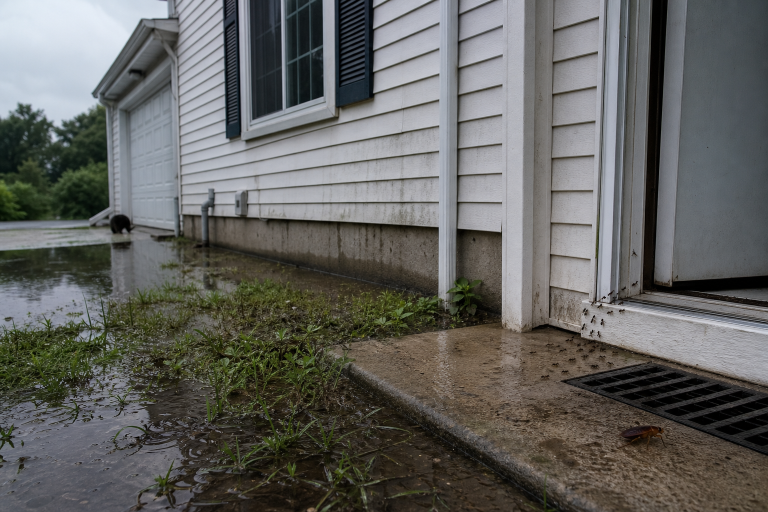
Scorpions are opportunistic hunters that establish territory based on food availability. According to the University of Arizona Cooperative Extension, managing prey populations is an essential component of long-term control. Homeowners often make the mistake of spraying exclusively for scorpions. However, if outer foundations, block walls, and irrigated landscaping are teeming with crickets or cockroaches, the underlying infestation that drives scorpion habitat remains.
Residual performance of pesticides can also be limited by dust, sunlight, irrigation, and surface type. The same product may last differently on concrete, stucco, soil, or mulch, depending on label directions and site conditions. That is one reason homeowners often think a treatment “stopped working” when the real issue is that the environment favors re-entry.
What actually makes a home scorpion-proof?
A more resistant home is built around exclusion, exterior cleanup, and targeted pest reduction, with pesticides used as support rather than the whole strategy.
The Centers for Disease Control and Prevention] advises preventing scorpion encounters by sealing cracks and openings, removing debris, and being cautious around places where scorpions hide. That is basic public guidance, but it lines up closely with what effective structural pest work looks like in the field.
Seal the entry points that matter most
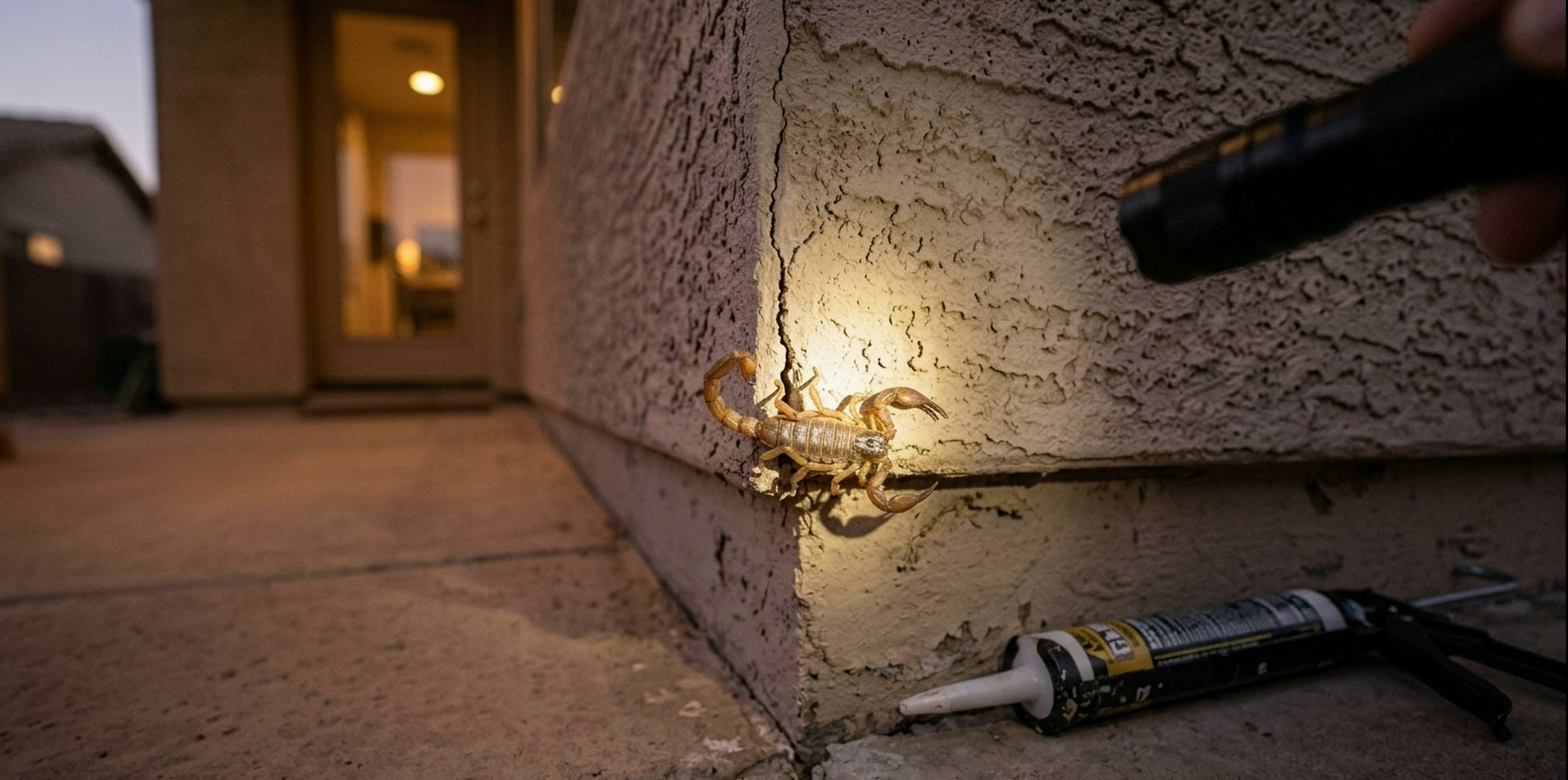
The most important openings are usually found at door thresholds, garage door edges, utility penetrations, attic and roofline gaps, weep screeds, foundation cracks, and window frame joints. A home does not need a dramatic hole to have a scorpion problem. Repeated small gaps around plumbing, conduit, weatherstripping, and masonry transitions are often enough.
Door sweeps matter more than many homeowners expect. If exterior light is visible under a side-hinged door or garage door when closed, that opening deserves attention first. For broader guidance on identifying vulnerable openings, Abodence has a related guide on pest entry point sealing.
Reduce the places scorpions hide outdoors
Dense ground cover, stacked materials, loose rock, wood piles, and cluttered storage near the structure create protected daytime shelter. University of California Agriculture and Natural Resources guidance on scorpions identifies harborage reduction as a key nonchemical control step, especially around foundations and yards with abundant cover.
That does not mean stripping the yard bare. It means creating cleaner edges near the house, keeping stored items off the ground when possible, and avoiding tight, undisturbed hiding zones right against exterior walls.
Control the insects that attract them
Fewer prey insects usually means less reason for scorpions to stay. The University of Arizona has tied successful management to reducing insects that scorpions feed on, especially around outdoor lighting and moist landscape areas.
Where do scorpions usually get in?
The most common entry routes are low-level gaps at doors and foundations, followed by penetrations for utilities and concealed openings around garages, attics, and wall lines.
Garage doors are a frequent weak point because the bottom seal and side seals wear out, and the slab may be uneven. Weatherstripping around man doors also compresses over time. In stucco and masonry homes, pipe penetrations and cable entries can leave narrow spaces that are easy to miss during casual inspection.
Rooflines can matter too, particularly where vents, eaves, or fascia transitions leave small openings. That is not the first place to start in every house, but it becomes relevant when lower-level sealing has already been addressed and activity continues.
For homes with visible envelope wear, the same inspection mindset used for windows and exterior penetrations can help. Abodence covers that broader approach in its guide to vetting door and window installers, which is useful when old frames and failed seals are part of the problem.
What should a real scorpion inspection include?
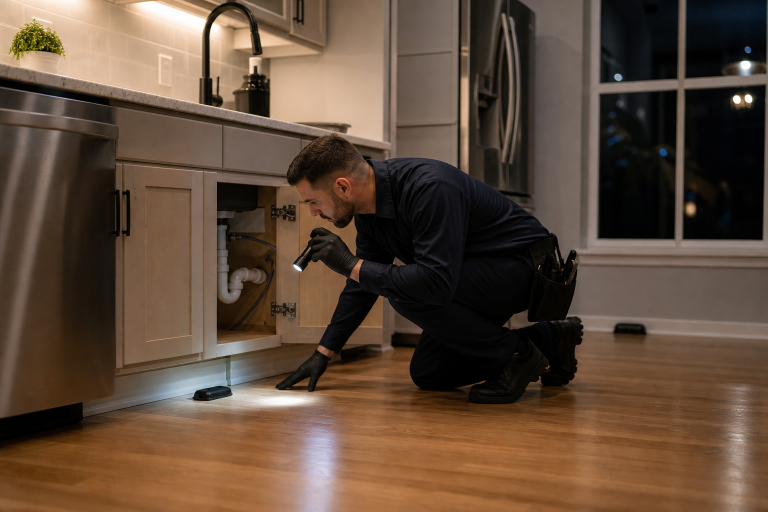
A useful inspection should map entry points, harborage, and prey-insect pressure, then connect each finding to a specific corrective step.
Vague service summaries are common in pest work. If a quote only says “spray interior and exterior” without describing exclusion findings, that is a sign the service may be too generic for a persistent scorpion issue.
A thorough scorpion-focused inspection usually includes:
- Door and garage seal checks
- Inspection of utility penetrations and foundation transitions
- Review of exterior clutter, stored materials, and dense landscape contact with the house
- Identification of moisture sources that support insect activity
- Assessment of prey insects around lights, irrigation, and perimeter zones
- A written scope separating sealing work from pesticide application
Some companies also use ultraviolet light inspections at night because scorpions fluoresce under UV. That can help confirm activity zones, but it is a diagnostic aid, not a substitute for structural correction.
Is bait, spray, or fumigation the best scorpion control method?
For scorpions, exclusion plus targeted exterior treatment is usually more useful than bait or fumigation, because the core problem is access and harborage rather than a whole-house airborne treatment scenario.
This is where the original “bait vs spray vs fumigation” framing needs a reality check.
Spray
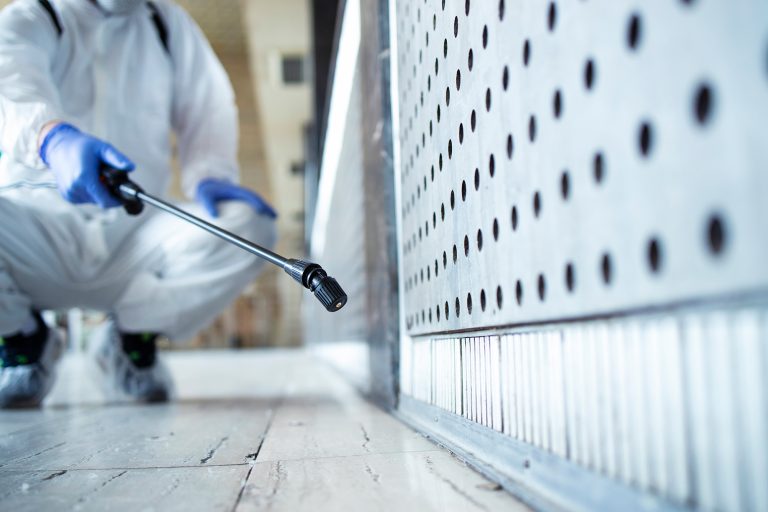
Residual spray can be part of a legitimate program when the product is labeled for scorpions and applied to likely travel routes and exterior harborage according to label directions. It can reduce activity, especially when paired with insect reduction. What it does not do is repair a leaky building envelope.
Bait
Baits are central for many pests, but they are not usually the lead tool for scorpions in residential control programs. Scorpions are predators, so broad bait strategies aimed at ants or roaches do not directly function the same way for scorpion elimination. They may help indirectly if they reduce prey populations, but that is different from baiting scorpions themselves.
Fumigation
Fumigation is generally associated with specific whole-structure pest situations and is not the standard answer for routine scorpion entry in occupied homes. The [California Department of Pesticide Regulation](https://www.cdpr.ca.gov/docs/dept/factshts/fumigat.htm) describes fumigation as a highly regulated treatment used for certain pests under controlled conditions. For a home with recurring scorpions at doors, garages, and wall gaps, that is usually the wrong problem-solving tool.
Electronic & Sonic Tools
In general, ultrasonic pest control devices are not effective and time and resources are better directed at prevention, direct control, and exclusion, according to the University of Arizona Cooperative Extension.
Commercial sonic and ultrasonic plug-ins claim to repel arthropods, but rigorous scientific studies have not shown them to be effective. Scorpions quickly habituate to or simply ignore these high-frequency sounds, making electronic repellers an unreliable strategy for exclusion.
What repairs and upgrades make the biggest difference?
The highest-value upgrades are usually door-bottom sealing, garage-door sealing, crack and penetration sealing, and cleanup that removes hidden outdoor shelter.
Those fixes are often modest compared with repeated specialty pest visits. Based on 2025 pricing from Angi and HomeAdvisor marketplace estimates, replacing door sweeps and weatherstripping commonly falls in the tens to low hundreds of dollars per opening, while garage door seal replacement often lands in a similar small-project range depending on door size and condition. Costs rise when masonry repair, stucco patching, or multiple utility penetrations need professional sealing.
Good materials matter and exterior-rated sealants, properly fitted sweeps, and durable garage seals hold up better than improvised patch jobs. The goal is a continuous barrier, not a temporary fill.
Lighting changes can help too. University of Arizona guidance notes that lights attracting insects can increase scorpion foraging nearby. In some homes, changing bulb type or reducing unnecessary nighttime lighting near entry doors lowers insect pressure enough to support the broader plan.
How do you know if your current pest service is too generic?
A generic program usually shows up as repeated spraying with little discussion of access points, prey insects, or structural corrections.
Watch for these patterns:
- No written findings about where scorpions are entering
- No recommendation for sealing doors, penetrations, or garage gaps
- No discussion of insect prey reduction
- Pressure to increase treatment frequency before basic exclusion is addressed
- Scope language that stays vague about products, target areas, and follow-up
That does not mean the company is doing something improper. It often means the service package is designed for broad pest maintenance, not for a pest that exploits tiny openings and spends much of its time hidden.
Can you fully eliminate scorpions from a property?
Complete elimination is rarely a realistic promise, but a well-sealed home can reduce indoor encounters sharply and make recurring activity much more manageable.
Outdoor pressure can continue from neighboring lots, block walls, drainage paths, and natural habitat. A trustworthy plan aims to reduce access and indoor sightings, not to promise a permanent zero-risk condition that the site may not support.
That is also why a “stronger chemical” is not always the better purchase. If your home still has visible light under doors, open utility penetrations, and cluttered foundation edges, fixing those items usually does more than upgrading to a premium spray package alone.
What is the practical order of operations for scorpion control?
The most effective sequence is inspection first, sealing second, habitat correction third, and pesticide treatment as a supporting layer.
That order keeps you from paying repeatedly for treatments while the same access points stay open. It also makes follow-up more meaningful, because you can judge whether remaining activity is coming from a specific unresolved gap or from broader outdoor pressure.
A practical homeowner plan looks like this:
- Get a scorpion-specific inspection with written findings.
- Repair door sweeps, weatherstripping, garage seals, and obvious penetration gaps.
- Remove or reorganize outdoor clutter and tight harborage near the house.
- Address prey insects around lighting, moisture, and perimeter zones.
- Use labeled residual treatments as part of the program, not as the whole program.
- Recheck after corrections to see whether sightings are indoor, outdoor, or both.
Homeowners dealing with other persistent pest entry issues often benefit from the same building-envelope mindset discussed in Abodence’s article on carpenter ant warning signs, where moisture and access also shape the real fix.
FAQ
Do scorpions mean your house is dirty?
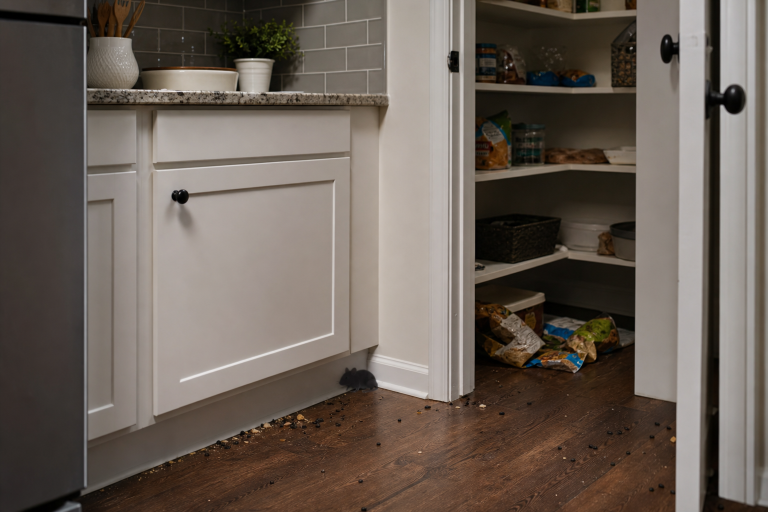
Indoor sightings usually point more to access and shelter than to housekeeping alone. Exterior clutter, prey insects, and small structural gaps are more relevant than whether a home looks clean.
Should you spray inside if you see one scorpion?
One sighting can justify inspection and targeted treatment, but broad indoor spraying by itself is often less useful than finding how it got in. Persistent sightings are a stronger signal that exclusion work is missing.
Are new homes safe from scorpions?
New construction can still have entry gaps around penetrations, thresholds, and garage assemblies. A newer home may have fewer wear-related openings, but it is not automatically sealed against scorpions.
How long does scorpion-proofing take?
Basic sealing and cleanup can often start in a single visit, while full correction depends on how many openings and landscape issues are present. Stubborn properties usually improve in stages rather than all at once.
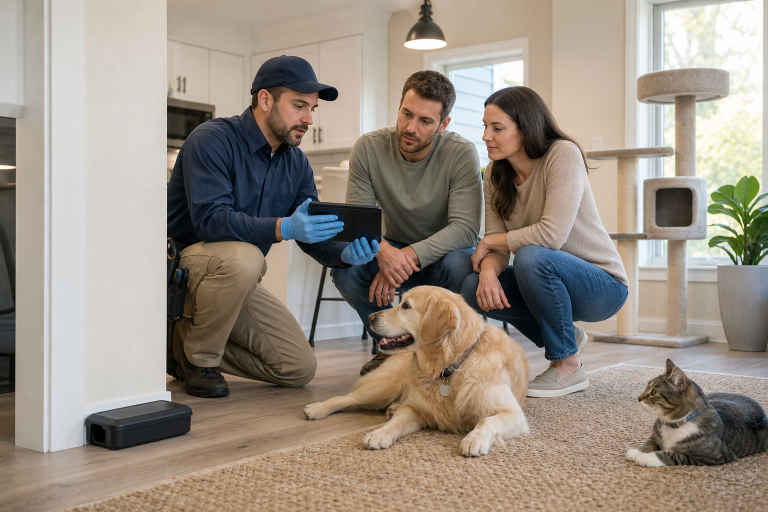
If scorpions keep showing up after standard pest treatments, getting a quote for a scorpion-specific inspection and exclusion plan is the practical next step. Please call one of the specialists listed for a no-obligation discussion.
Sources: National Pest Management Association, University of Arizona Cooperative Extension, Syngenta Demand CS product label, BASF Talstar P product label, University of California Agriculture and Natural Resources, Angi, HomeAdvisor