Stuck Heat Pump Reversing Valve? Critical Signs Homeowners Should Know
Focus Keyword: stuck heat pump reversing valve

Call for a free estimate:
Reversing valve issues usually show up as a heat pump that cools when it should heat, heats when it should cool, or seems locked into one mode no matter what the thermostat says. If that is happening, this is not a good DIY repair. A reversing valve is part of the sealed refrigerant system, and diagnosing it correctly usually requires gauges, electrical testing, and confirmation that the problem is the valve itself rather than the thermostat, control board, or low-voltage circuit.
The reversing valve is the component that lets a heat pump switch between heating and cooling. According to the U.S. Department of Energy, a heat pump works by moving heat rather than generating it directly, and it can provide both heating and cooling through that refrigeration cycle. When the valve does not shift as intended, the system can no longer route refrigerant the right way.
In many service calls, the real issue is a bad solenoid coil, a wiring fault, a thermostat signal problem, or contamination inside the refrigeration circuit. Knowing the difference matters because some of those repairs are far smaller than replacing the valve itself.
Which symptoms are caused by a stuck heat pump reversing valve?
The most common pattern is a system that runs, but the air coming from the registers does not match the mode you selected. You may set the thermostat to heat and get cool air, or switch to cooling and still get warm air. In some homes, the equipment appears to be permanently stuck in one mode.
Manufacturer service literature treats mode-change problems as a control or refrigerant-circuit issue that has to be equipment verified. Trane service documentation for heat pumps describes the reversing valve as a refrigerant-direction component controlled by a solenoid. Carrier product literature describes the same basic function. If the valve body does not slide internally, or if the solenoid never gets the signal needed to shift it, the system can stay in the wrong operating mode.
You might also notice that the temperature in the house changes very slowly even though the outdoor unit and indoor fan are both operating. That symptom alone does not prove the valve is stuck, because low refrigerant charge, compressor problems, or airflow issues can also reduce performance. It does tell you that normal thermostat adjustments are not solving the problem.
How can you tell whether the reversing valve is broken or whether something else is causing it?
A correct answer usually comes from ruling out the control side before condemning the valve itself. HVAC technicians typically verify thermostat commands, low-voltage output, solenoid operation, and refrigerant pressures before calling the valve failed.
According to the AHRI residential heat pump overview, heat pumps depend on coordinated refrigerant-system components to move heat in either direction. That means a symptom that looks like a stuck heat pump reversing valve can also come from another part of that system failing to respond.
Signs that point toward the reversing valve
Some symptoms do make the valve more suspicious than other faults:
- The unit is locked in heating or locked in cooling.
- The thermostat changes modes, but supply air does not.
- The outdoor unit runs and the indoor blower runs, yet the system behaves like it never switched over.
- A technician confirms the solenoid is energized correctly, but the refrigerant circuit still does not reverse.
Signs that point toward a different problem
Other symptoms often overlap with control, airflow, or refrigerant issues instead:
- Weak airflow from the vents.
- Frequent on-off cycling.
- Ice buildup or defrost complaints without a clear mode-change failure.
- Temperature problems that happen only sometimes, especially after thermostat changes or power interruptions.
If your system is blowing warm air in cooling mode, a reversing valve is one possible cause, but it is not the only one. Abodence covers other likely causes in warm air from your A/C.
Why does a reversing valve get stuck?
The usual causes are electrical failure at the solenoid, internal mechanical sticking, or contamination in the sealed system. Those are very different repairs, which is why a technician should identify the failure before recommending parts.
Copeland application guidance for heat pump systems and Danfoss reversing valve technical literature both describe the valve as a precision refrigerant component that depends on correct pressure relationships and clean system conditions. In practice, that means several things can go wrong.
Solenoid coil failure
A failed solenoid coil may prevent the valve from shifting even if the thermostat is calling correctly. In some systems, replacing the coil is possible without opening the refrigerant circuit. When that is the confirmed fault, it is usually simpler and less expensive than replacing the whole valve body.
Internal valve sticking
Wear, debris, or internal damage can keep the slide inside the valve from moving freely. Once that happens, the system may remain in one mode or switch only intermittently. This is the scenario most homeowners mean when they say the valve is stuck.
Low-voltage control problem
A thermostat issue, damaged wire, loose connection, or control board fault can stop the valve from receiving the signal to change modes. That can mimic a bad valve almost perfectly from the living space.
Contaminated refrigerant circuit
Moisture, debris, or burnout residue in the sealed system can interfere with valve operation and can damage more than one component. In that case, replacing the valve alone may not fix the root cause.
Call for a free estimate:
Is it safe to keep running a heat pump with a stuck reversing valve?
Continued operation is usually a bad idea, especially if comfort is poor or the system is short cycling. The problem needs professional diagnosis because the equipment may keep running inefficiently, and a sealed-system fault can lead to a larger repair if ignored.
According to the U.S. Environmental Protection Agency, refrigerant handling is regulated and sealed-system work must be done by properly qualified technicians. A reversing valve sits directly in that sealed system, so this is not a homeowner repair item.
If the unit is a gas/electric package system or if you are unsure whether another heating source is involved, it is reasonable to stop experimenting with settings and call for service. For broader safety context around HVAC faults, Abodence also covers related issues in critical HVAC troubleshooting and safety.
What will an HVAC technician check before saying the reversing valve is bad?
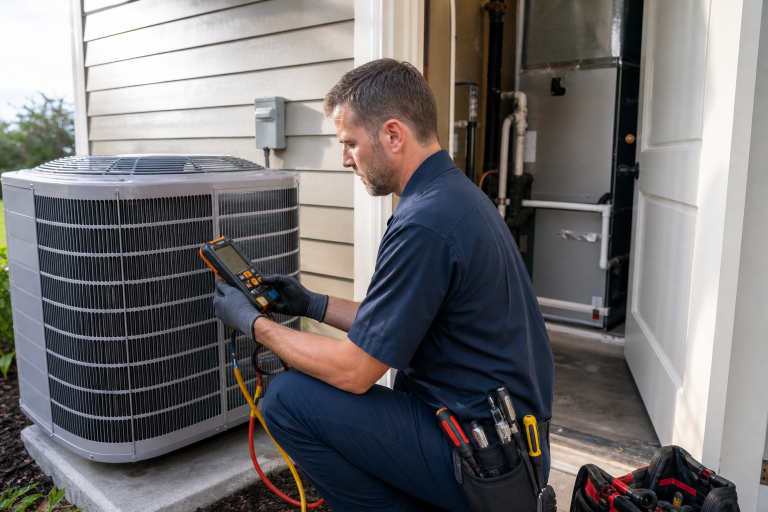
A solid diagnosis starts with controls and measurements, not with an immediate parts recommendation. The technician should verify the thermostat call, confirm whether the solenoid is being energized, and compare system behavior with refrigerant readings and temperature split.
That process often includes:
- Checking whether the thermostat is actually sending the mode-change signal.
- Testing low-voltage wiring between thermostat, air handler, and outdoor unit.
- Measuring whether the reversing valve coil is energized when it should be.
- Confirming the coil itself has failed or is intact.
- Reading refrigerant pressures and temperatures to see whether the circuit has truly reversed.
- Looking for signs of contamination or a larger compressor-related problem.
A vague statement like “you need a new heat pump” is not enough at this stage. If the diagnosis is a stuck heat pump reversing valve, the company should be able to explain whether the failed part is the coil, the valve body, or a control component that only made the valve appear bad.
How much does stuck heat pump reversing valve repair usually cost?
Roughly $200-600 for a solenoid-related repair and about $800-1,500 or more for full reversing valve replacement is a reasonable 2026 market range, based on HomeAdvisor marketplace estimates and Angi 2026 pricing pages for heat pump and HVAC repair categories. Those figures are broad estimates, not a substitute for a written local quote.
The higher range reflects labor intensity. Replacing the valve body usually means recovering refrigerant, brazing in a new valve, pressure testing, evacuating the system, and recharging it to manufacturer specifications. If the system uses an older refrigerant or has contamination elsewhere, the final cost can rise further.
Sometimes the cheaper fix is the right one. If testing shows the solenoid coil or low-voltage control is the only failed part, replacing the entire valve or the entire heat pump would be hard to justify.
When does replacing the whole heat pump make more sense than replacing the reversing valve?
An equipment replacement conversation becomes more reasonable when the system is older, uses an obsolete or expensive refrigerant, or has multiple major faults beyond the valve. A single failed valve does not automatically mean the whole heat pump should be replaced.
According to ENERGY STAR, certified heat pumps are available in high-efficiency configurations that can reduce energy use compared with older equipment, but replacement decisions still depend on the condition of the existing system and the quality of the repair option in front of you. If the compressor is also failing, the coil is leaking, or the refrigerant type makes repair unusually expensive, replacement may be the cleaner long-term choice.
Ask for the decision in writing. A useful quote should separate the cost to repair the confirmed fault from the cost to replace the equipment, and it should identify any additional issues that make repair a poor value.
What questions should you ask before approving a reversing valve repair?
A short list of specific questions will tell you whether the diagnosis is careful or rushed. You are looking for a clear explanation of what failed, how it was tested, and whether the repair addresses the whole problem.
- Was the thermostat signal to the valve confirmed at the unit?
- Is the failed part the solenoid coil, the valve body, or another control component?
- Were refrigerant pressures and temperatures checked to confirm the valve is not shifting?
- Is there any sign of contamination or compressor damage in the sealed system?
- Will the repair require recovering and recharging refrigerant?
- What warranty applies to the part and the labor?
- If replacement was suggested, what specific finding makes repair a poor value?
Those questions help expose a common trade problem: vague quotes that jump from symptom to full-system replacement without showing the diagnosis in between.
Can a stuck heat pump reversing valve unstick itself?
Intermittent operation can happen, but relying on that is not a repair plan. A valve may appear to switch again after a power cycle, a thermostat change, or changing pressure conditions, yet the underlying fault can still be present.
That pattern often points to a marginal solenoid, an unstable control signal, or an internal mechanical problem that has not failed completely. Waiting for it to get worse may only make the diagnosis easier after comfort has already dropped.
FAQ
Can a thermostat make it seem like the reversing valve is bad?
Yes, a bad thermostat or low-voltage control problem can mimic a failed valve because the heat pump may never receive the signal to switch modes. A technician should verify the control signal before condemning the valve body.
Will a stuck reversing valve always stop the system completely?
No, many systems with this fault still run, but they run in the wrong mode or stay locked in one mode. That is why homeowners often notice comfort problems before they notice a full shutdown.
Call for a free estimate:
Is reversing valve replacement a routine repair?
No, this is generally a more involved sealed-system repair than common electrical or airflow fixes. It usually requires refrigerant recovery, brazing, evacuation, and recharge by a qualified technician.
Should you get a second opinion on a reversing valve diagnosis?
Yes, a second opinion is reasonable when the quote is large or when replacement is recommended quickly. A good diagnosis should explain what tests confirmed the valve itself is the failed part.
If your heat pump is stuck in the wrong mode and you need clarity on whether the issue is the reversing valve, the practical next step is to schedule a service diagnosis and ask for the failed component and repair scope in writing. Please call one of the listed professionals for a free, no-obligation discussion.
Sources: Trane service documentation, Carrier product literature, Copeland application guidance, Danfoss technical literature, HomeAdvisor, Angi