Safe Pest Control for Pets and Children: What Homeowners Should Know
Safe pest control for pets and children starts with a simple rule: the product label and the treatment plan matter more than marketing terms like “natural” or “family-friendly.” If you are trying to decide whether a pest treatment is appropriate around kids and animals, the right question is not whether all pest control is safe or unsafe. The useful question is which product is being used, where it is being applied, how exposure is limited, and what the label requires before people and pets re-enter the area.

Call for a free estimate:
In the U.S., pesticides must be used according to the label approved under the Federal Insecticide, Fungicide, and Rodenticide Act, and the U.S. Environmental Protection Agency explains that the label includes directions for safe use. Those directions can cover who should stay out of the area, how long to wait before re-entry, and where a product can and cannot be applied. A treatment that is appropriate when used exactly as labeled can become the wrong choice if it is applied in the wrong place or if re-entry directions are ignored.
For many homes, the safest effective plan is also the least dramatic one: targeted treatment, limited access to treated areas until the label allows re-entry, and non-chemical exclusion steps that reduce how often pesticides are needed at all. If you want a broader overview of lower-exposure approaches, Abodence also covers eco-friendly pest control and when it does or does not change the result.
Are pest control treatments safe for pets and children?
Many treatments can be used with an acceptable margin of safety when the product is selected correctly and applied exactly as labeled, but “safe” is never a blanket promise for every product, pest, or home. The National Pesticide Information Center notes that children can be more sensitive to pesticides than adults, which is why exposure reduction matters so much in real-world use. The same practical logic applies to pets, especially animals that groom themselves, spend time on floors, or can reach bait stations, granules, or treated surfaces.
The most accurate way to judge a treatment is to look at four things together: the active ingredient, the formulation, the application site, and the label directions. A crack-and-crevice gel bait placed inside a wall void is a different risk than exposure from a broadcast spray on baseboards. A locked rodent bait station outdoors is different from loose bait placed where a dog can reach it. A flea treatment plan for carpets is different from a wasp treatment on an exterior eave.
That distinction matters because homeowners are often sold a category, not a plan. “Pet-safe” is not a regulated all-purpose service description. The real protection comes from whether the company identifies the exact product, follows the label, and gives you clear written instructions for preparation and re-entry.
What makes one pest treatment lower risk than another?
Lower-risk treatment usually means less access, less drift, and less residue in places where children and pets spend time. According to the EPA’s consumer guidance on reducing pesticide exposure, exposure can be reduced by choosing targeted methods and following directions carefully. In practice, that usually favors contained baits, crack-and-crevice applications, and exterior-focused work over broad indoor spraying when those other options can solve the pest problem.
Targeted placements usually expose fewer household members
Gels, enclosed baits, and void applications are often chosen because they put the product where the pest is active instead of across open living areas. That does not make them automatically harmless. It does mean there is less treated surface available for a crawling toddler or a curious pet to contact when the placement is done correctly.
Formulation changes the exposure pattern
Dusts, sprays, granules, aerosols, and baits behave differently. A liquid applied to a baseboard, a dust placed in a wall void, and a bait in a tamper-resistant station are not interchangeable from an exposure standpoint. If a company cannot explain why a specific formulation fits your pest and your home layout, that is a reason to slow down and ask more questions.
Location matters as much as the ingredient
Outdoor perimeter work may reduce indoor exposure in some cases, while indoor treatment may still be necessary for pests such as German cockroaches or bed bugs. The point is not that one location is always better. The point is that the treatment area should match the pest’s biology and your household’s traffic patterns.
Which pest control methods are usually the best fit for homes with pets and kids?
The best fit is usually an integrated pest management approach that combines sanitation, exclusion, monitoring, and the most targeted treatment that can realistically solve the infestation. The Centers for Disease Control and Prevention describes integrated pest management as a strategy that uses multiple methods to control pests while reducing unnecessary pesticide use.
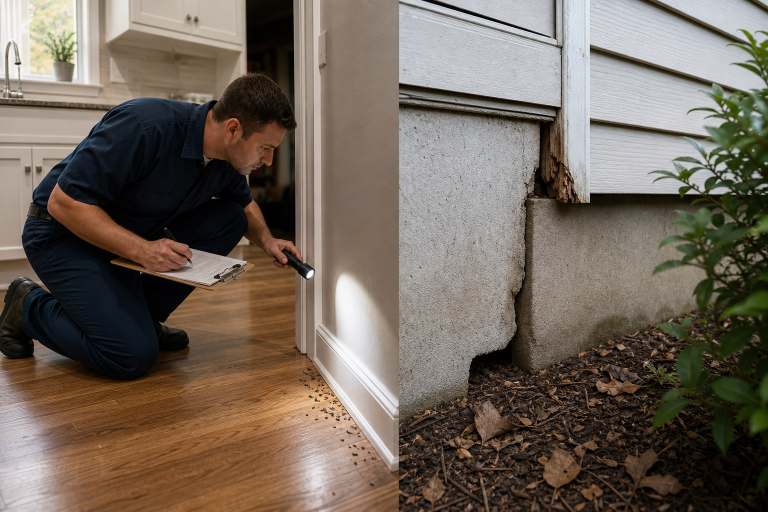
For homeowners, that often looks like fixing entry points, removing food and water sources, using traps or monitors where appropriate, and reserving pesticide use for targeted placements. If ants are entering through a gap at a window frame, sealing the gap may matter as much as the treatment itself. If pantry pests are breeding in stored dry goods, disposal and cleaning may do more than another spray visit.
A technician who recommends non-chemical steps first, or recommends a smaller treatment area because the problem is localized, is not underselling the job. In many cases, that is the more credible plan.
What should you ask before scheduling pest control?
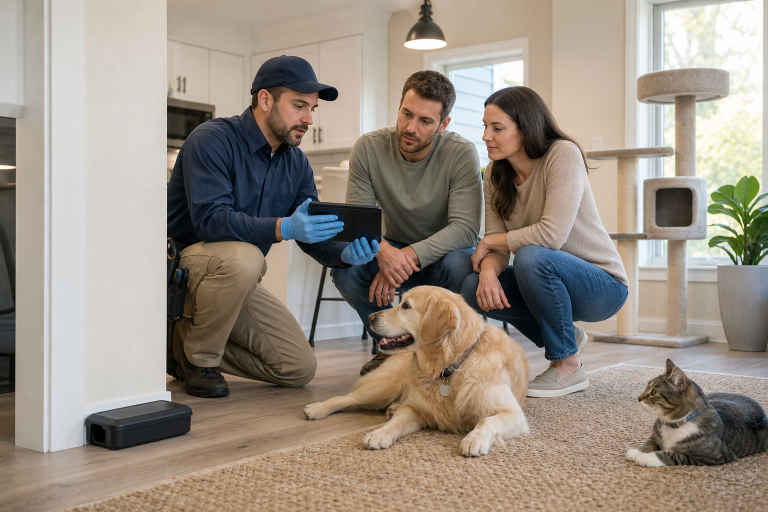
You should ask for the exact product names, the application locations, and the re-entry instructions before approving service. Vague reassurance is not enough, especially if you have a crawling child, a cat, or a dog that licks floors and paws.
- What pest is being treated, and how was it identified?
- What exact products will be used?
- Where will each product be applied?
- Will the treatment be a bait, crack-and-crevice application, dust, spray, or granule?
- What preparation is required before service?
- How long must children and pets stay out of treated areas?
- When is it safe to resume normal use of floors, furniture, or the yard?
- Are there non-chemical steps that could reduce the scope of treatment?
- Will bait stations be tamper-resistant and placed out of reach?
- Can you provide the product label or Safety Data Sheet on request?
If the answers are fuzzy, or if the company leans on phrases like “totally safe” without naming products and instructions, keep looking. Clear scope is one of the easiest ways to spot a careful provider. For a deeper look at pre-treatment planning, Abodence also covers pest control safety for parents and pet owners.
When should children and pets stay away after treatment?
The correct wait time is whatever the product label and the applicator’s instructions require for that specific treatment. The EPA’s information on pesticide labels explains that labels may include re-entry statements and other use restrictions, and those instructions are the controlling source, not a generic rule of thumb.
In practical terms, that means one treatment may require staying out until sprays have dried, while another may involve avoiding a lawn until a stated interval has passed, and another may rely on enclosed bait placements that are inaccessible during normal use. There is no accurate single answer that covers all products.
If your household includes pets that lick surfaces, free-roam small animals, or children who play on floors, ask the company to explain not just the official re-entry time but also which areas should be blocked off, cleaned, or avoided afterward. That is especially important with food preparation areas, pet feeding zones, litter box areas, and toys stored near treatment sites.
Are “natural” or “green” pest treatments automatically safer?
Products marketed as natural or green are not automatically the safer choice for every household or every pest problem. The label, the exposure route, and the application method still control the real-world risk profile.
Call for a free estimate:
Some minimum-risk pesticide products are exempt from EPA registration requirements under specific conditions, while many botanical or essential-oil-based products are still pesticides with use directions and limitations. A pleasant scent or plant-based ingredient does not answer the questions that matter most: where will it be applied, how much residue will remain, and can it solve the infestation without repeated broad applications.
Repeated low-effect treatments can create their own problem if they increase total indoor application frequency without actually fixing the source. For some infestations, a targeted conventional product used once in a limited area may be the cleaner plan than frequent whole-room applications of a weaker alternative.
What mistakes increase risk during pest control service?
Preventable problems usually come from poor communication and poor containment, not from homeowners failing to understand chemistry. Most people do not need a pesticide science lesson. They need a clear plan.
- Approving treatment without getting the exact product names
- Letting pets or children re-enter before the stated time
- Leaving pet bowls, toys, or bedding in treatment zones
- Using over-the-counter products on top of professional treatment without asking first
- Ignoring entry-point repairs, food storage, or moisture issues that keep the infestation going
- Accepting loose rodent bait placement where a pet could access it
Another common issue is scope creep. A quote for “general pest control” can hide a much broader application than you expected. Ask whether the service is targeted to a specific room, an exterior perimeter, a void, or a full interior treatment. Those are very different levels of exposure and should not be bundled into one vague line item.
How can you make a pest treatment plan safer without making it ineffective?
Start by reducing the amount of area that needs treatment at all. Sealing gaps, storing food in closed containers, fixing leaks, trimming vegetation away from the house, and reducing clutter can shrink the pest pressure before any product is applied.
Then ask the provider to match the treatment to the pest and to your household habits. A home with a toddler and a dog may need different placement choices than a home with no pets and no young children. A cat that jumps onto counters creates a different planning problem than a dog that stays on the floor.
It also helps to schedule service when you can actually follow the instructions. If you will not be able to keep pets out of the yard or children out of a room for the required interval, that is not the right day for treatment. Rescheduling is better than improvising after the fact.
When is professional pest control the better choice than DIY?
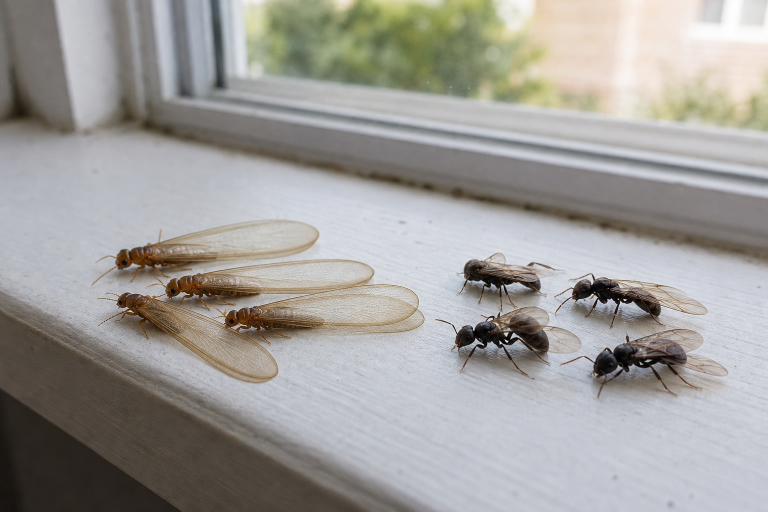
Professional service is often the better choice when the pest is hard to identify, the infestation is established, or the treatment requires restricted-use knowledge, specialized placement, or careful exclusion work. Misidentifying the pest can lead to the wrong product in the wrong place, which adds exposure without solving the problem.
That is especially true for rodents, stinging insects in wall voids, German cockroaches, bed bugs, and recurring infestations that keep coming back after store-bought treatment. In those cases, a focused professional plan may reduce total pesticide use by avoiding repeated trial-and-error applications.
DIY can still be reasonable for limited, clearly identified problems if you read and follow the label exactly and can keep children and pets away from treated areas. If you cannot do both, the cheaper option stops being the practical option.
FAQ
Can pets stay in the house during pest control treatment?
Sometimes they can, but only if the product label and the applicator’s instructions allow it for the untreated areas of the home. Many treatments require pets to be removed from specific rooms or kept out until a stated re-entry condition is met.
Is indoor spraying necessary for most pest problems?
No, many pest issues can be handled with targeted placements, monitoring, and exclusion instead of broad indoor spraying. The right scope depends on the pest, the infestation level, and where activity is actually happening.
Are bait stations safer than sprays around children and pets?
Contained stations often reduce access compared with open applications, but only when they are tamper-resistant and placed where children and animals cannot interfere with them. The exact product and placement still matter.
Should you clean right after a pest treatment?
Sometimes yes, but only in the specific way the provider instructs for that product and treatment area. Cleaning too aggressively or too soon can remove a treatment that was meant to remain in place, while failing to clean food-contact areas when instructed can create avoidable exposure.
What is the safest pest control approach for families with babies or crawling toddlers?
The safest practical approach is usually the most targeted one, combined with strict re-entry compliance and strong non-chemical prevention. Homes with very young children benefit from avoiding unnecessary treated surfaces in floor-level living areas whenever a narrower method can solve the problem.
If you are comparing treatment options for a specific pest, getting a written plan with product names, placement details, and re-entry instructions is the clearest next step. Please call a listed specialist for a free, no-obligation discussion.
Sources: National Pesticide Information Center, Centers for Disease Control and Prevention