HVAC Furnace Repair: Expert Guidance for Safer, Faster Decisions
Focus Keyword: HVAC furnace repair
Decisions on HVAC furnace repairs are easiest when you separate urgent safety issues from routine service problems, understand what a quote should include, and know when repair is still the sensible option. For gas-fired equipment, the biggest concerns are combustion safety, venting, and fuel gas piping, all of which are governed by codes and manufacturer instructions rather than guesswork. According to the U.S. Department of Energy, furnaces need regular maintenance to operate efficiently and safely, and replacement choices should be based on efficiency, age, and condition rather than on sales pressure alone.
If your furnace will not start, keeps shutting off, smells like gas, or is making new loud noises, the right next step depends on which symptom you have. Some problems point to a simple service call. Others require immediate shutdown and professional help.
When is HVAC furnace repair an urgent safety issue?
Any gas smell, visible soot, scorch marks, repeated burner shutdowns, or signs of venting trouble should be treated as a professional call, not a DIY project. For fuel gas systems, the code framework comes from the International Fuel Gas Code, and furnace manufacturers also require installation and service to follow their published instructions. If you smell gas, leave the area and contact the gas utility or emergency service provider, then arrange licensed HVAC service.
Electric furnaces can also present urgent issues. Burning odors, tripped breakers that reset and trip again, melted wire insulation, or sparking all point to an electrical fault that should be inspected by a qualified technician. The same caution applies if the furnace cabinet is hot in places it normally is not.
What problems usually lead to an HVAC furnace repair?
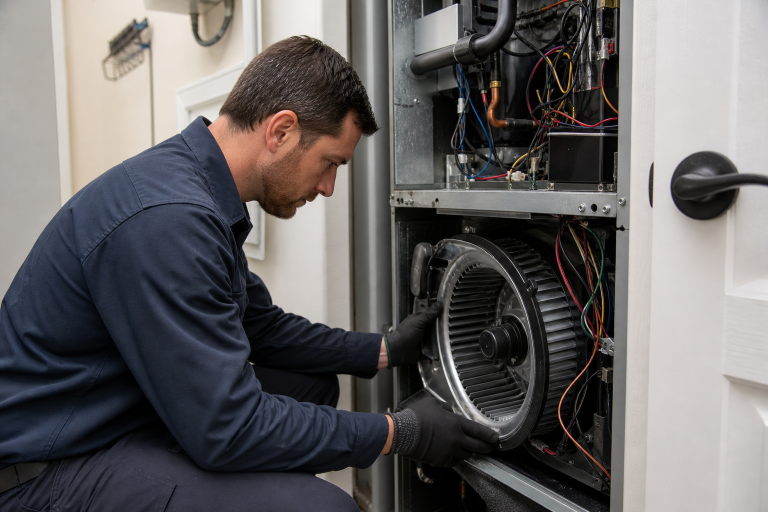
Most service calls come down to ignition failure, airflow restriction, control faults, blower problems, or safety-switch shutdowns. The Department of Energy names dirty filters and neglected maintenance as common performance issues, while manufacturer service literature commonly points to igniters, flame sensors, pressure switches, limit switches, and blower assemblies as frequent failure points.
A clogged filter, failed thermostat, blocked condensate drain on a condensing furnace, or weak inducer motor can all stop heat production. If the blower is part of the problem, this related Abodence guide on HVAC blower motor problems is worth reading because blower symptoms often overlap with furnace complaints.
Common symptoms and what they often point to
- Furnace starts, then shuts off quickly: flame-sensing issue, airflow problem, or limit-switch trip
- No heat, but blower runs: ignition or burner problem
- No response at all: power, control board, thermostat, or door-switch issue
- Rattling, screeching, or grinding: blower wheel, motor bearings, inducer assembly, or loose panels
- Water near the unit: condensate drainage issue on a high-efficiency furnace
How much does HVAC furnace repair cost?
About $130 to $500 is a common 2025 range for many furnace repairs, while major component work can run higher depending on the part and labor involved. For broad market pricing, Angi’s 2025 furnace repair cost guide lists a national range of roughly $131 to $486, with higher totals possible for heat exchanger, blower motor, or control board work. That figure is useful as a planning benchmark, but your actual quote will be effected by region, emergency timing, and the exact failed component.
Part pricing varies by equipment design and brand-specific compatibility. A hot surface igniter may be a relatively modest repair. A blower motor, inducer motor, or control board usually lands higher. Heat exchanger failures are often the turning point, because the part is expensive, labor is substantial, and warranty coverage can be limited to the part rather than labor, depending on the manufacturer’s warranty terms.
Ask for an itemized quote with the diagnostic fee, part cost, labor, warranty on the repair, and whether return trips are included if a special-order part is needed. Vague one-line estimates make it hard to compare offers and easy to miss exclusions.
Should you repair the furnace or replace it?
Replacement makes more sense when the heat exchanger is damaged, the repair is unusually expensive relative to the furnace’s age, or the system has a pattern of repeated failures. According to ENERGY STAR, certified gas furnaces are available at higher efficiency levels than many older units, which can matter if your current equipment is well past midlife and already facing a major repair.
Age alone is not enough to justify replacement. A furnace with a minor igniter or sensor issue can still be a rational repair, especially if the heat exchanger is sound and the rest of the system is in good condition. On the other hand, a large repair on an older unit with poor efficiency and a history of breakdowns can turn into repeated spending.
Use this repair-versus-replace checklist
- Repair is usually reasonable when: the problem is isolated, the quote is moderate, and the furnace has otherwise been reliable
- Replacement deserves a serious look when: the heat exchanger is compromised, warranty coverage is limited, or multiple major parts are near end of life
- Get a second opinion when: the diagnosis is a cracked heat exchanger, failed control board plus blower assembly, or any recommendation that appears immediately tied to a full-system upsell
If you are also comparing equipment types, Abodence has a useful article on HVAC variable-speed systems that explains one of the most common upgrade decisions homeowners face during replacement quotes.
What should a professional HVAC furnace repair visit include?
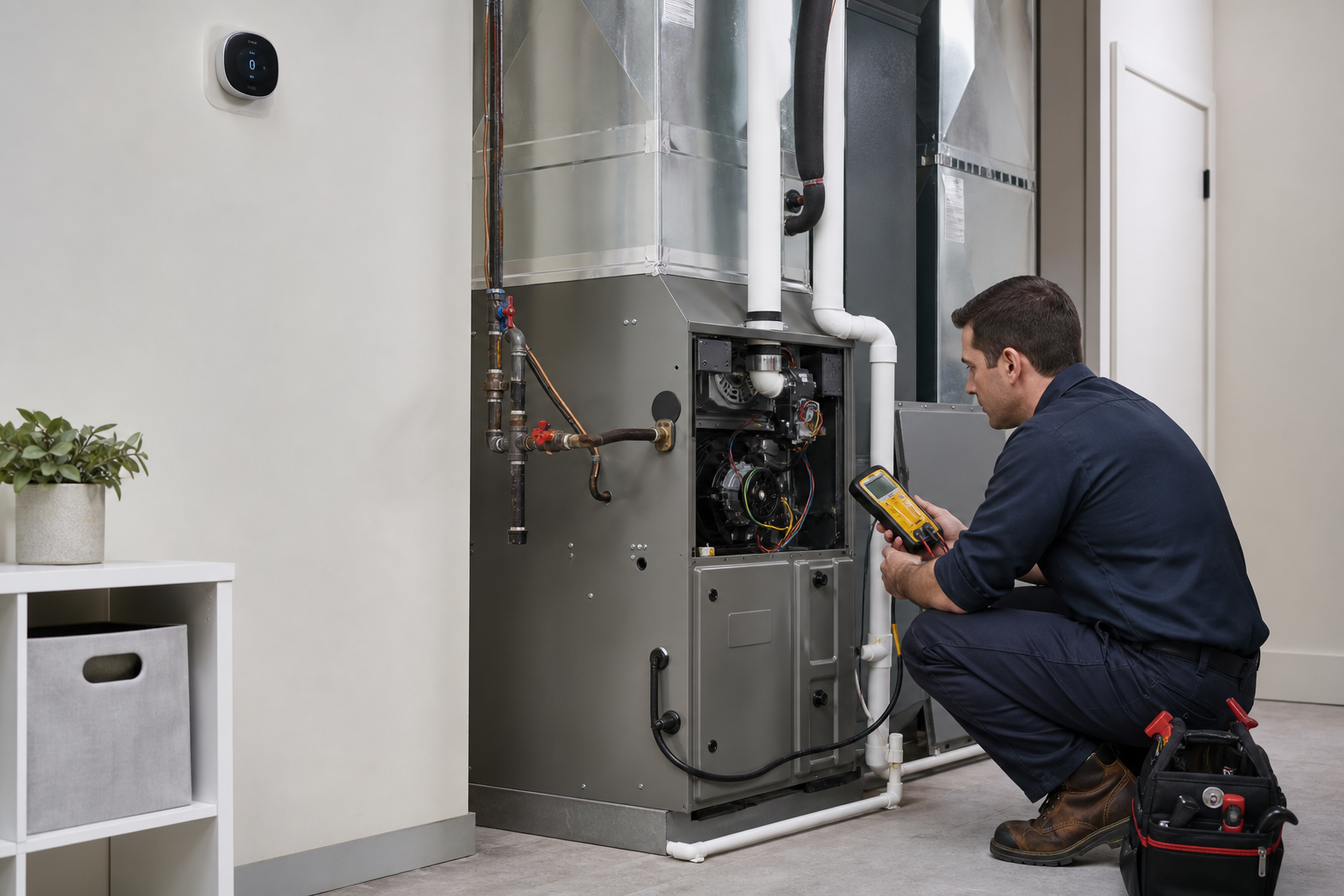
A competent service visit should document the fault, verify safe operation, and explain whether the quoted fix addresses the root cause or only the symptom. The Air Conditioning Contractors of America, through its quality installation and service guidance, emphasizes proper system evaluation rather than part swapping based on guesswork.
For a gas furnace, technicians commonly verify ignition sequence, burner operation, venting condition, temperature rise, safety controls, condensate management on high-efficiency models, and blower performance. For electric models, the visit should include checks of sequencers, heating elements, wiring condition, and amp draw where appropriate.
How can you tell whether a furnace repair quote is solid?
The best quotes are specific enough that another contractor could review them and understand the proposed work. You should see the diagnosed problem, the exact part or assembly being replaced, whether OEM or universal parts are being used, labor charges, warranty terms, and any safety-related findings that are separate from the repair itself.
Watch for three common problems in furnace quotes:
- Vague scope: wording like “repair furnace” without naming the failed part or test result
- Bundled pressure: a repair quote that is immediately folded into a same-day replacement pitch without a clear explanation of why a repair is unreasonable
- Unclear warranty language: no written statement on part warranty, labor warranty, or whether the diagnostic fee applies to approved work
Manufacturer warranty documents also matter here. Many furnace warranties distinguish between registered and unregistered coverage, original owner status, and part-only versus labor coverage. Ask the contractor to check the model and serial number against the manufacturer’s published warranty terms before you approve a costly repair.
What can you do before calling for HVAC furnace repair?
Basic checks can help you describe the problem clearly, but they should stop well short of opening gas or electrical components. Confirm that the thermostat is set correctly, the service switch is on, the breaker has not tripped, and the filter is not heavily clogged. If your furnace uses a condensate safety switch, check whether water is backing up around the drain assembly.
Do not remove burner components, bypass safety switches, or keep resetting a furnace that repeatedly locks out. Repeated resets can mask the pattern a technician needs to see and can worsen a safety problem.
If the symptom is a gas odor, sparking, or signs of overheating, skip all homeowner checks and make the call immediately.
How do maintenance and installation quality affect future furnace repairs?
Long-term reliability depends heavily on correct sizing, airflow setup, venting, and routine maintenance. According to the U.S. Department of Energy’s maintenance guidance, neglected HVAC systems lose performance and face more avoidable wear, and the same principle applies to heating equipment. Manufacturer installation instructions also set required clearances, vent lengths, combustion-air rules, and setup procedures that directly affect service life.
Poor installation creates repair patterns that look like bad luck but are really setup problems. Examples include incorrect temperature rise, undersized return air, improper venting, and drainage issues on condensing units. Replacing a failed part without correcting the setup issue can lead to another service call.
What questions should you ask before approving HVAC furnace repair?
The right questions will tell you whether the contractor has identified the actual fault and whether the repair is likely to last. Keep the conversation practical and specific.
- What exact part failed, and what test confirmed it?
- Is this an isolated repair or a sign of a larger airflow, venting, or control problem?
- Will the replacement part be OEM, and if not, what is the compatibility basis?
- What warranty applies to the part and the labor?
- Is there any safety-related issue that must be addressed before the furnace is returned to service?
- If this furnace were your own budget decision, would you repair it or price replacement, and why?
The last question is useful because it pushes past generic sales language. A good answer should mention age, condition, repair scope, and expected value, not just “it depends.”
FAQ
Is HVAC furnace repair worth it on an older system?
Moderate repairs can still be worth doing if the furnace has been reliable and the heat exchanger is sound. Once the quote involves a major component on an older unit, comparing repair cost with replacement pricing becomes the practical next step.
How long does a furnace repair usually take?
Many common repairs are completed in one visit if the part is on the truck. Special-order parts, warranty verification, or additional safety findings can extend the timeline by several days.
Can a dirty filter cause a furnace to stop heating?
Restricted airflow can trigger safety shutdowns on some furnaces, which is why filter condition is one of the first basic checks. If replacing the filter does not restore normal operation, the system still needs proper diagnosis.
What is the most expensive furnace repair?
Heat exchanger work is often among the most expensive because the part and labor are substantial, and the repair can overlap with broader safety and replacement decisions. Exact cost depends on the model, warranty status, and local labor rates.
Should you get a second opinion on a furnace diagnosis?
A second opinion is sensible when the diagnosis is a cracked heat exchanger, a high-dollar control issue, or an immediate recommendation for full replacement. Major decisions are easier to trust when two written evaluations point to the same conclusion.
If you need help sorting out a repair quote or deciding whether a furnace problem calls for service or replacement pricing, you can use Abodence to explore more HVAC guidance or connect with help for your specific situation.
Sources: Angi furnace repair cost guide (2025), Air Conditioning Contractors of America quality installation and service guidance, manufacturer furnace installation instructions and warranty documents