HVAC Repair Assistance: FEMA, LIHEAP, and IRA Aid
A failed furnace, air conditioner, heat pump, or air handler can create a large unplanned expense, but several public programs may reduce the cost when the circumstances fit. FEMA assistance addresses qualifying disaster damage. LIHEAP and the Weatherization Assistance Program serve income-qualified households through state and local agencies. Inflation Reduction Act rebates are state-run incentives for certain high-efficiency equipment and electrical upgrades.

Call for a free estimate:
These programs have different purposes, deadlines, and rules. A storm-damaged outdoor unit may belong in a FEMA application, while an aging but working furnace may be better suited to weatherization or a state energy-rebate program. Not every program will help everyone, treating each source of aid as a general HVAC repair fund is a common reason homeowners waste time or miss a deadline.
Which public programs may help with an HVAC expense?
The right program depends first on why the equipment needs work, then on household income, disaster status, and the type of replacement being considered. FEMA’s Individuals and Households Program may help eligible households after a presidentially declared disaster. The U.S. Department of Health and Human Services administers LIHEAP funding for states, territories, and tribes, which can support energy bills, crisis assistance, weatherization, and certain energy-related home repairs under local program rules. The U.S. Department of Energy supports Weatherization Assistance Program services for income-qualified households. State energy offices administer the federal Home Energy Rebates created by the Inflation Reduction Act.
None of these programs promises to pay every invoice. Assistance may be limited by available funding, the scope of damage, the applicant’s income, an energy assessment, insurance proceeds, or a state-approved list of equipment. Start with the program that matches the immediate problem rather than replacing equipment first and assuming reimbursement will follow.
- Disaster damage: check FEMA after a federal disaster declaration for your area.
- Energy bill emergency or low income: contact the LIHEAP office or community action agency serving your address.
- Efficiency work in an income-qualified home: ask the local Weatherization Assistance Program provider about its intake list and inspection process.
- Replacement with qualifying efficient electric equipment: use your state’s official Home Energy Rebates portal before signing a contract.
When can FEMA assistance cover a damaged heating or cooling system?
FEMA may provide Home Repair Assistance when a declared disaster damages an eligible owner-occupied primary residence and the damage makes the home unsafe, unsanitary, or nonfunctional. FEMA describes this aid as support to restore a home to a safe, sanitary, and functional condition, rather than funding to return it to its pre-disaster condition or pay for upgrades. Its Individuals and Households Program page also makes clear that applicants must meet eligibility requirements and that FEMA assistance cannot duplicate insurance or other benefits.
For HVAC equipment, the key facts are causation and documentation. The application should connect the furnace, heat pump, air conditioner, or related electrical component to the declared event. Keep photographs of the condition, insurance correspondence, repair estimates, contractor findings, receipts for temporary protective measures, and proof that the property is your primary residence. FEMA determines eligibility case by case and may inspect the home or request more information.
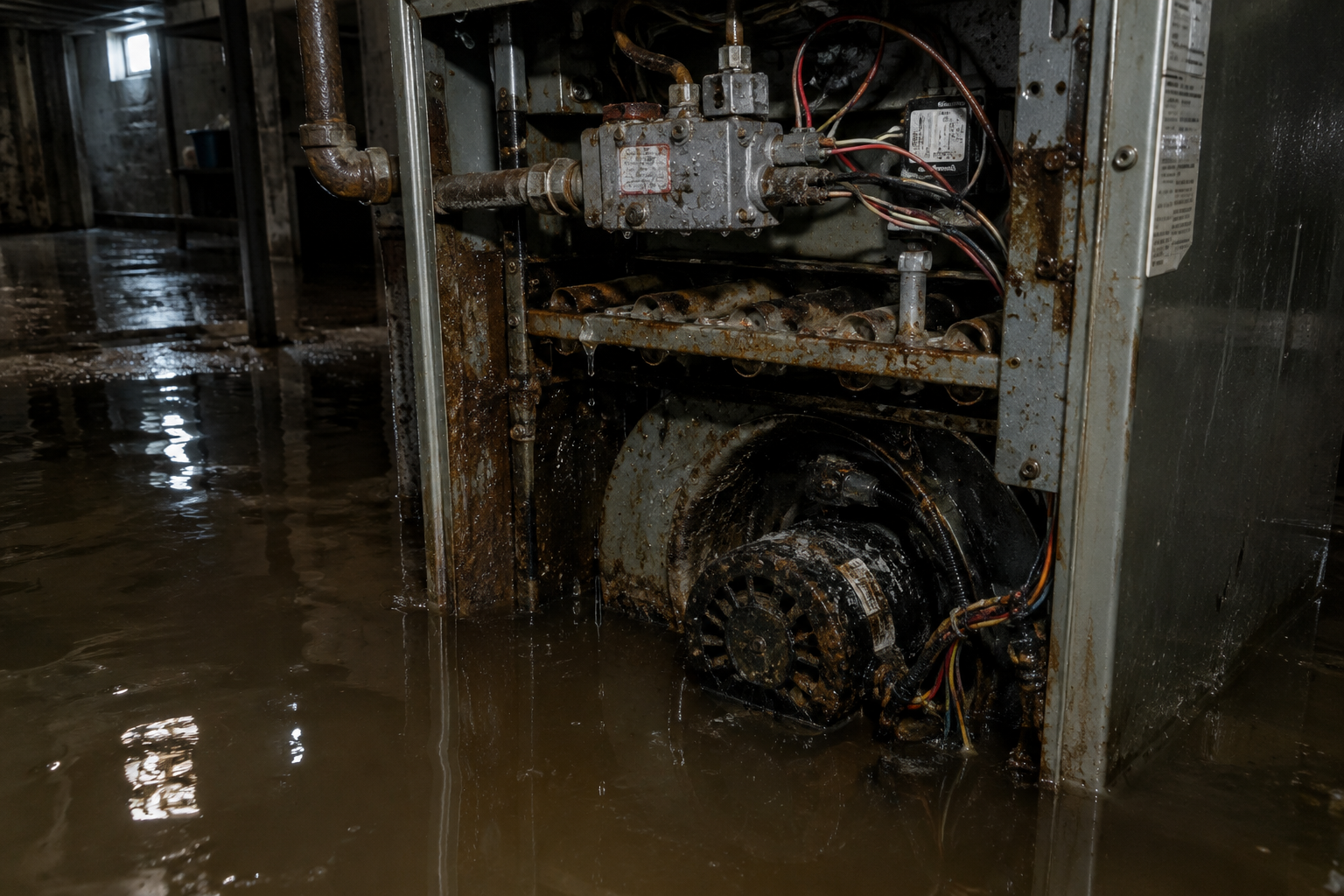
If floodwater reached electrical or fuel-burning HVAC equipment, leave the unit off and arrange an assessment by a qualified professional. Restarting damaged equipment is not an appropriate shortcut while an assistance application is pending. Homeowners dealing with a flooded system can also review HVAC safety checks after flooding before arranging service.
Apply during the registration period announced for the specific disaster, even if an insurer has not completed its decision. FEMA says insurance must be used first when coverage applies, but an applicant may still be considered for uninsured or underinsured disaster-related needs. A denial or award that does not cover the documented need may have an appeal path under the notice instructions, subject to FEMA deadlines.
How do LIHEAP and weatherization help when there was no disaster?
LIHEAP can address an energy emergency or reduce the household energy burden, but the exact HVAC support is set by the state, territory, or tribal program administering the funds. According to the HHS Office of Community Services LIHEAP program page, grants are provided to states, territories, and tribes, which operate their own eligibility rules and benefit structures within federal requirements. Some local programs can authorize crisis support or energy-related repair, while others focus on utility bills, reconnection, or seasonal assistance.
Income eligibility is therefore local, not one national household-income number. Ask the administering agency which income definition it uses, whether it considers household size, whether homeowner status is required for a repair benefit, and whether funds remain for the current program year. Households receiving other means-tested benefits may have simplified eligibility in some locations, but the local agency must make that determination.
The Weatherization Assistance Program is a different route. The Department of Energy states that households at or below 200 percent of the federal poverty level are eligible for its program, while households receiving Supplemental Security Income or Aid to Families with Dependent Children (now TANF) are categorically eligible. State and local providers may prioritize households such as older adults, people with disabilities, families with children, and high-energy-burden households under their program plans.
Weatherization is built around an assessment of the house, not a menu of homeowner-selected upgrades. The DOE’s Weatherization Assistance Program explains that providers use energy audits to identify cost-effective measures and may address health and safety issues needed to complete the work. The approved scope may include heating-system work when it is justified by the assessment and local program rules. It may also focus on air sealing, insulation, duct work, or controls instead of replacing the main unit.
How do Inflation Reduction Act state rebates apply to HVAC replacements?
State Home Energy Rebates can reduce the installed cost of qualifying high-efficiency electric equipment, especially heat pumps, but they are not a universal rebate for repairing an existing furnace or air conditioner. The Department of Energy’s Home Energy Rebates program describes two state-administered tracks: the Home Efficiency Rebates, often called HOMES, and the Home Electrification and Appliance Rebates, often called HEAR. Each state decides when its program opens and publishes its own participating-contractor, equipment, reservation, and payment rules.
For HEAR, federal program limits provide greater support for low-income households, defined as below 80 percent of area median income, and partial support for moderate-income households from 80 to 150 percent of area median income. The federal ceiling for a qualifying heat-pump HVAC installation is up to $8,000, subject to the household’s income category, the state program design, and the project meeting all requirements. States may use point-of-sale discounts, reservations, or post-installation processes, so the state portal should be checked before work begins.
HOMES rebates use measured or modeled whole-home energy savings rather than a fixed rebate for one appliance. That can make HOMES relevant when an HVAC replacement is part of a broader project, but it also means the project may need specified documentation and verification. A contractor’s claim that a heat pump is “IRA eligible” is incomplete unless it identifies the state program, the applicable rebate track, the qualifying model or performance requirements, and who will submit the required records.
Federal tax credits and state rebates are separate forms of support. A tax credit affects a future tax return and may have different equipment requirements, while a rebate may lower the invoice or reimburse an approved project. Do not assume one application enrolls you in the other.
What should you gather before applying for HVAC help?
A complete file makes it easier for an agency or contractor to determine whether the problem and project fit the program. Gather documents before an emergency becomes a same-day replacement decision whenever possible.
- Government-issued identification and proof that the home is your primary residence, when the program requires it.
- Recent utility bills, account notices, and shutoff or crisis notices for LIHEAP-related requests.
- Income documentation for everyone the agency says counts as part of the household.
- Insurance declarations, claim information, damage photos, and repair estimates for FEMA-related losses.
- Written equipment proposals that state the scope, model information, labor, electrical work, permit responsibility, and warranty terms for a rebate project.
- Confirmation from the state rebate portal that the contractor and proposed equipment meet the current program rules.
Ask for a written scope rather than accepting a one-line replacement price. The proposal should separate equipment, labor, electrical upgrades, duct changes, permits, disposal, and any work excluded from the price. This reduces scope disputes and lets you compare whether a rebate covers the actual project or only one part of it.
Call for a free estimate:
What limits should homeowners expect from these programs?
Public assistance often has a timing rule that matters as much as eligibility. FEMA applies only to a declared disaster and a documented disaster-related need. LIHEAP and weatherization depend on local funding cycles and provider capacity. State rebates can require an approved contractor, preapproval, or a reservation before installation. Work completed too early may be ineligible even when the household and equipment would otherwise qualify.
Ownership and occupancy rules also differ. FEMA Home Repair Assistance is tied to an owner-occupied primary residence. Weatherization and LIHEAP providers can serve renters in some circumstances, but landlord permission and property-specific rules may apply. A state rebate may use household income, area median income, or project-level requirements that do not match another program’s test.
Do not accept pressure to replace a system solely because assistance might be available. A documented repair can be the sensible choice when it restores safe, reliable operation and the unit does not otherwise warrant replacement. For a broader decision framework, see how to weigh HVAC repair versus replacement.
For a project that does move forward, request a written estimate from a qualified HVAC contractor and ask the local program administrator which documents must be submitted before the work is authorized.
FAQ
Can FEMA pay for a furnace or air conditioner after a storm?
Potentially, if the equipment was damaged by a federally declared disaster, the home is an eligible primary residence, and the applicant meets FEMA’s requirements. Insurance must be used first when coverage applies, and FEMA will not pay for the same loss twice.
Is LIHEAP available only for utility bills?
No, local LIHEAP programs may also provide crisis assistance, weatherization support, or energy-related repair help, but the available benefits vary by state, territory, tribe, and local administering agency. Contact the agency serving your address for its current options and application window.
Can an IRA rebate pay for a standard air-conditioner repair?
Usually no, because the state Home Energy Rebates are designed around qualifying energy-efficiency projects and electric equipment, not routine repair invoices. Check the current state program before authorizing a replacement, since requirements and availability differ by location.
Should a homeowner wait for aid before replacing failed HVAC equipment?
Waiting can preserve eligibility when a program requires preapproval, but a no-heat, flood-damaged, or otherwise unsafe system needs prompt professional attention. Ask the relevant program whether emergency procedures, temporary measures, or after-the-fact documentation are allowed before making a nonemergency replacement decision.
If you are facing an HVAC failure, contact the applicable local assistance agency and request a detailed written HVAC quote that leaves room for the program’s approval process.
For additional help, please call a listed specialist for a free, no-obligation discussion.