HVAC Indoor Air Quality Options for a Healthier, Cleaner Home
HVAC indoor air quality starts with a few practical reminders that affect how clean, comfortable, and well-managed your home feels day to day.
Most indoor air quality problems tied to heating and cooling are not solved by one product. They are usually improved by a combination of filter changes, the right fan settings, controlled humidity, source control, and routine equipment maintenance. According to the U.S. Environmental Protection Agency guide to indoor air quality, common ways to improve indoor air include controlling pollutant sources, improving ventilation, and using air cleaners when appropriate.
That keeps many homeowners from wasting money on add-ons they may not need.
If you are already comparing equipment options, Abodence also covers HVAC variable-speed systems and how they can affect airflow control and comfort.
What should you remember first about HVAC indoor air quality?
The most useful first step is to treat airflow, filtration, ventilation, and moisture as one system rather than four separate issues.
Your furnace or air handler moves air. Your filter captures some particles, but only if it fits correctly and the system can handle its resistance. Ventilation brings in outdoor air or helps remove stale indoor air. Humidity control limits excess moisture in summer and overly dry air in winter. According to the U.S. Department of Energy guidance on maintaining air conditioners, replacing or cleaning filters regularly can lower energy use and help systems run more effectively.
A reminder that matters here: a better filter is only better if your system is designed to use it. A very restrictive filter can reduce airflow if the blower and duct system are not matched to it.
How often should you change your HVAC air filter?
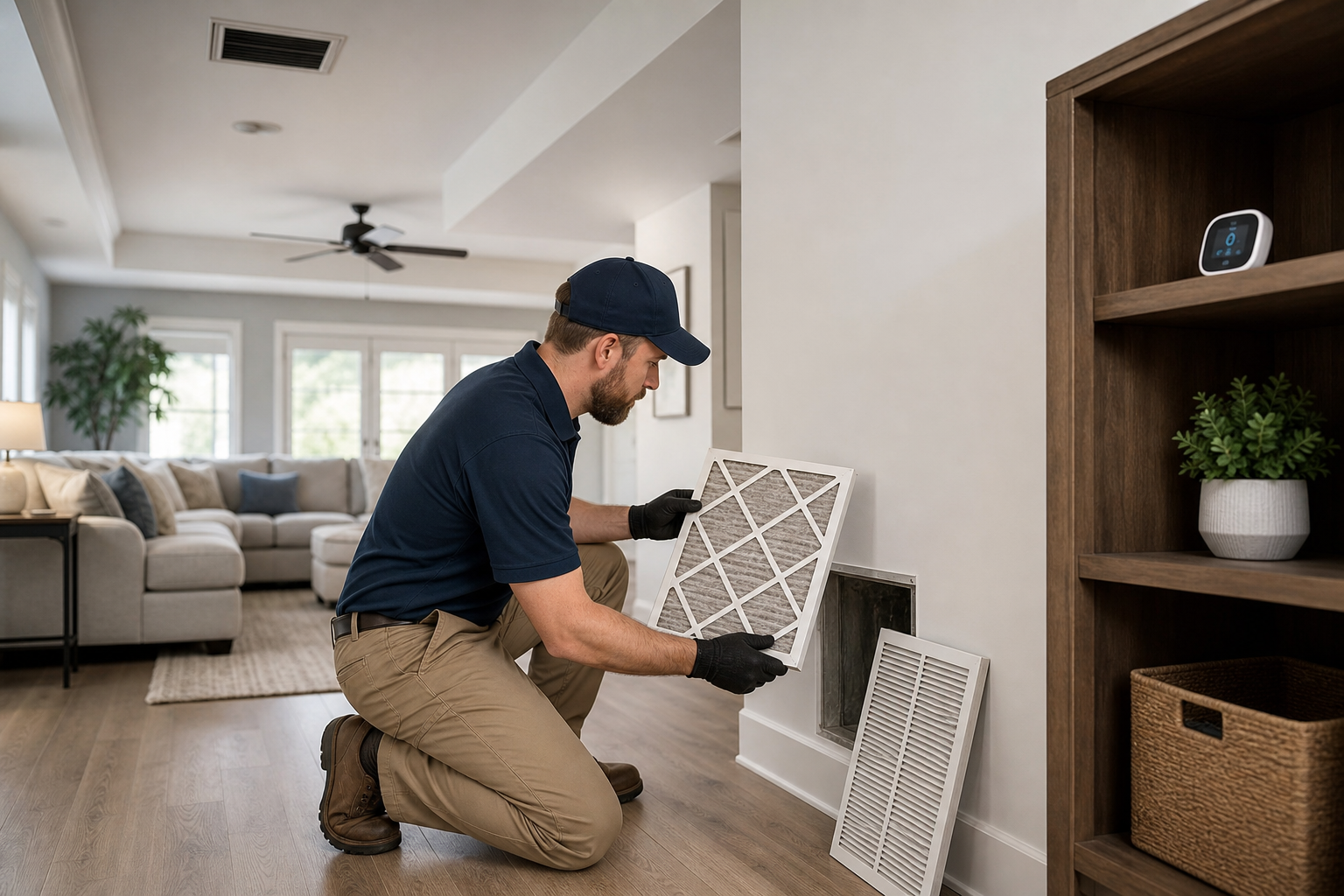
Many homes need a filter check every quarter and a replacement on the schedule listed by the equipment maker or filter manufacturer, not on a fixed rule you saw online.
Manufacturer guidance varies by filter type and system design. Carrier homeowner guidance says some filters may need monthly attention, while others can last longer depending on use and conditions. Trane and Lennox publish similar maintenance guidance that ties replacement timing to occupancy, pets, dust load, and filter style. The practical reminder is simple: inspect the filter monthly and replace it when loaded, or follow the published interval for that exact product if it is still visibly clean.
What filter details matter most?
The important details are size, fit, and the manufacturer-approved performance level.
A filter that leaves gaps around the frame can let air bypass the media. A high-rated filter that chokes airflow can create comfort and equipment problems. The Air Conditioning Contractors of America, or ACCA, and major manufacturers consistently frame airflow as a core part of system performance. If you want to move to a higher-efficiency filter, ask for the equipment model compatibility and static pressure impact from the manufacturer in writing.
Does running the HVAC fan all the time improve indoor air quality?
Continuous fan operation can improve filtration and room-to-room air mixing, but it is not automatically the best setting for every home.
When the fan runs longer, more air passes through the filter. That can help with particle capture and can even out temperatures between rooms. But longer runtime also uses more electricity, and in some climates it can work against moisture control if the system is not set up for it. According to ENERGY STAR guidance on air cleaners and filters in the home, filtration works best when air regularly moves through the system, but filter choice and proper installation still matter.
If your thermostat offers a circulation mode, that setting can be a useful middle ground because it runs the fan periodically instead of nonstop. Check your thermostat manual and your HVAC manufacturer guidance before changing schedules.
What humidity level should you aim for indoors?
A moderate indoor humidity range is generally the target, with many manufacturers and HVAC trade references centering comfort around roughly 30 to 50 percent relative humidity.
AprilAire, a major indoor air quality system manufacturer, and Carrier both use that general range as a practical benchmark for comfort and moisture management. The reminder is to verify the level with a hygrometer instead of guessing from how the air feels. Humidity that stays too high can point to oversized cooling equipment, short run times, duct leakage, or weak spot ventilation in bathrooms and kitchens. Air that stays too dry in winter may call for humidification, but only after checking for air leaks and overly aggressive heating cycles.
Can your HVAC system fix indoor air quality by itself?
Heating and cooling equipment helps, but source control inside the home still does much of the work.
The EPA guidance cited above places source control first for a reason. If dust, combustion byproducts, cleaning product fumes, or moisture are created indoors, the HVAC system can only manage part of that load. Good reminders include using kitchen and bath exhaust fans as intended, sealing return duct leaks, keeping supply and return vents unobstructed, and avoiding storage of paints or chemicals in areas connected to return air pathways. Even a very capable system cannot fully make up for poor housekeeping around vents, persistent moisture problems, or blocked airflow.
Which HVAC upgrades actually help indoor air quality?
The right upgrade depends on the problem you are trying to solve, and the simplest fix is often the right one.
If the issue is basic dust buildup, better filter management and duct sealing may matter more than a premium air cleaner. If the issue is uneven comfort and poor dehumidification, a variable-speed system may help because it can run longer at lower output, which can improve moisture removal when properly designed. For a broader overview of that equipment type, see Abodence on variable-speed HVAC systems.
What are the most common upgrade categories?
Most indoor air quality add-ons fall into a few clear categories, each with a different job.
- Media filters: Thicker cabinet-style filters that can capture more particles with lower pressure drop than some 1-inch filters, depending on design and manufacturer specs.
- Portable air cleaners: ENERGY STAR notes these can be useful for room-level filtration, especially when matched to room size.
- Whole-home ventilation equipment: Options such as ERVs and HRVs, which exchange stale indoor air with outdoor air while managing energy loss, are commonly specified where highly sealed homes need planned ventilation.
- Humidifiers and dehumidifiers: These address moisture balance, not particle filtration.
- UV products: These are application-specific and should be evaluated against the manufacturer’s stated use, lamp replacement schedule, and installation requirements.
How do you know when indoor air quality is really an HVAC issue?
Recurring airflow, filtration, and moisture patterns usually point to the HVAC side, while isolated room conditions may point elsewhere.
Useful HVAC-related signs include rooms that are consistently stuffy, visible dust around supply registers soon after cleaning, filters loading unusually fast, condensation near vents, or a system that cycles so briefly that it never seems to settle the house. ACCA design principles and manufacturer service literature both treat airflow balance, duct integrity, and equipment sizing as core checks when comfort and air management do not line up.
By contrast, a single damp bathroom may be a spot ventilation problem. Dust from an attached garage may be a pressure or sealing issue near the house envelope. The reminder is to define the pattern before buying equipment.
What maintenance reminders make the biggest difference?
The highest-value reminders are the boring ones: check filters, keep vents open, verify drainage, and schedule professional service on the manufacturer’s interval.
According to the Centers for Disease Control and Prevention information on mold, moisture control is a central part of preventing mold problems in buildings. For HVAC, that means paying attention to clogged condensate drains, wet insulation near air handlers, and persistent dampness around cooling equipment. Manufacturer maintenance literature from Carrier, Trane, and Lennox also consistently includes coil cleanliness, blower inspection, and drain checks because these affect airflow and moisture handling.
- Inspect the air filter monthly.
- Keep supply and return vents clear of furniture, rugs, and drapes.
- Check that the condensate drain is functioning during cooling season.
- Use bath and kitchen exhaust fans during moisture-producing activities.
- Schedule professional maintenance as your equipment manufacturer recommends.
- Ask for duct leakage or static pressure testing if airflow problems keep returning.
What mistakes do homeowners make with HVAC indoor air quality?
The most common mistakes are overspending on add-ons, ignoring airflow restrictions, and assuming dust always means dirty ducts.
Dust can come from filter bypass, return leaks, attic or crawlspace leakage, or ordinary indoor activity. A duct cleaning pitch should not substitute for system inspection. The National Air Duct Cleaners Association publishes standards for cleaning when it is appropriate, but even that trade group frames source identification and system condition as part of the decision. If no one has checked filter fit, blower performance, and return leakage, a sales-heavy recommendation is incomplete.
Another frequent mistake is closing too many supply registers to force air into favorite rooms. That can disrupt airflow balance and raise system resistance.
What should you ask an HVAC contractor about indoor air quality?
The best questions focus on diagnosis, measurements, and manufacturer compatibility, not brand slogans.
- What specific problem are you trying to solve: particles, ventilation, humidity, or airflow balance?
- What measurements support that diagnosis: humidity readings, static pressure, airflow, or duct leakage?
- Is the recommended filter or accessory approved for my equipment model?
- Will this change fan performance or static pressure?
- What maintenance does this product require, and how often?
- If this is a ventilation recommendation, what standard or design basis are you using?
- Is there a lower-cost step to try first before installing new equipment?
Clear answers here usually tell you more than a long feature list.
FAQ
Is a higher MERV filter always better for HVAC indoor air quality?
A higher MERV filter can capture smaller particles, but it is only a good choice if your system can handle the added resistance and the manufacturer allows it.
Should you have your air ducts cleaned to improve indoor air quality?
Duct cleaning can help in specific conditions, but it should follow an inspection that identifies contamination, leakage, or buildup rather than being treated as an automatic fix.
Do portable air purifiers help if you already have central HVAC?
Portable air cleaners can help in individual rooms, especially when their room-size rating matches the space and your central system does not run continuously.
Can a smart thermostat improve indoor air quality?
A smart thermostat can help indirectly if it offers fan circulation scheduling, humidity-related controls, or better runtime management that supports filtration and comfort.
When should you call for professional HVAC indoor air quality help?
Persistent humidity problems, repeated airflow complaints, fast-loading filters, visible moisture near equipment, or recurring dust despite routine maintenance are reasonable times to get a system assessment.
If you want help sorting out whether your next step is maintenance, testing, or an actual equipment upgrade, you can review options through the Abodence HVAC category or request help with your specific situation through Abodence services.
Sources: Carrier, Trane, Lennox, Air Conditioning Contractors of America (ACCA), AprilAire, National Air Duct Cleaners Association (NADCA)