How to Verify HVAC Contractor Licensing & Insurance
Hiring an HVAC contractor involves more than comparing an estimate and an installation date. Licensing, insurance, and refrigerant credentials are separate records, and each answers a different question about who may perform the work, what coverage may apply if something goes wrong, and whether the company can lawfully handle regulated refrigerants.

Call for a free estimate:
Start the verification before you sign a contract or pay a deposit. A legitimate document does not automatically make a contractor the right fit, but missing, expired, or mismatched records are reasons to pause.
What should you verify before hiring an HVAC contractor?
Confirm the contractor’s legal business name, active license status, insurance evidence, and the credentials required for the exact work being proposed.
The Federal Trade Commission’s guidance on avoiding home-improvement scams advises consumers to check licensing and insurance before hiring.
- Ask for the full legal business name, street address, phone number, and license number shown on the contract.
- Look up that license through the official licensing agency for the state where the work will occur.
- Ask for a current certificate of insurance and identify the issuing insurance agent or carrier.
- Match the named insured on the insurance certificate to the legal entity on the estimate and contract.
- For refrigerant work, ask which technician will hold the applicable EPA credential.
A trade name, a salesperson’s name, and a parent company name may differ from the legal entity that will sign the contract. The contract should plainly identify the company that holds the license and carries the coverage. Keep copies of the license lookup result, insurance certificate, proposal, signed contract, and change orders in one project file. Those records can make it far easier to resolve a disagreement about scope, payment, or responsibility later.
How do you check an HVAC contractor’s license?
The state licensing database is the controlling place to confirm whether a business holds an active license in the right classification for the work.
Requirements differ by state, county, and city. Some jurisdictions issue a statewide contractor license, while others add local registration, mechanical permits, or both. Do not assume that a license from a neighboring state authorizes work at your address. Call the local building department if the online records do not make the local requirement clear.
California provides a useful example of the records a public lookup can show. The California Contractors State License Board license check displays license status, classification, bond information, workers’ compensation information, and certain disciplinary information. Your state’s database may show fewer fields, but the same comparison method applies.
Match the record to the proposed scope
Read the classification, not only the word “active.” An HVAC replacement may involve heating, cooling, ductwork, electrical connections, controls, condensate drainage, or gas piping. The prime contractor should explain which work it will perform under its own authority and which portions, if any, will be handled by properly qualified subcontractors.
Ask who will pull permits and schedule required inspections. Permit responsibility should appear in the written scope, including permit fees and any work excluded from the price. A vague promise to “handle permits if needed” leaves a material question unresolved.
License verification also cannot tell you whether a proposed system is correctly sized or whether the quote includes all needed duct and electrical work. Review those technical decisions separately, including the factors outlined in this guide to choosing the correct HVAC unit size.
What insurance should an HVAC contractor be able to document?
A current insurance certificate should identify the insured business, policy type, policy period, carrier or agent, and limits, but it should be verified rather than treated as a guarantee of coverage.
“General liability coverage” is typically the policy homeowners ask about for property-damage claims connected to contracted work. Workers’ compensation coverage addresses a different exposure involving employees. Commercial auto coverage may also matter when company vehicles are part of the job. The policy requirements, exclusions, limits, and whether a particular event is covered depend on the actual policy and state law.
Ask for documents that address the work at hand:
- A certificate of commercial general liability insurance.
- Evidence of workers’ compensation coverage, or a written explanation of the contractor’s lawful exemption if one applies in your state.
- The name and contact information for the issuing agent or insurer.
- Written confirmation of any project-specific requirement, such as additional-insured status, if your contract requires it.
Do not confuse a contractor bond with liability insurance. A bond and an insurance policy are different financial arrangements, with different claim procedures and limits. If a licensing lookup shows a bond, ask the licensing authority what its bond requirement covers before treating it as protection for unfinished work or property damage.
When does EPA refrigerant certification matter?
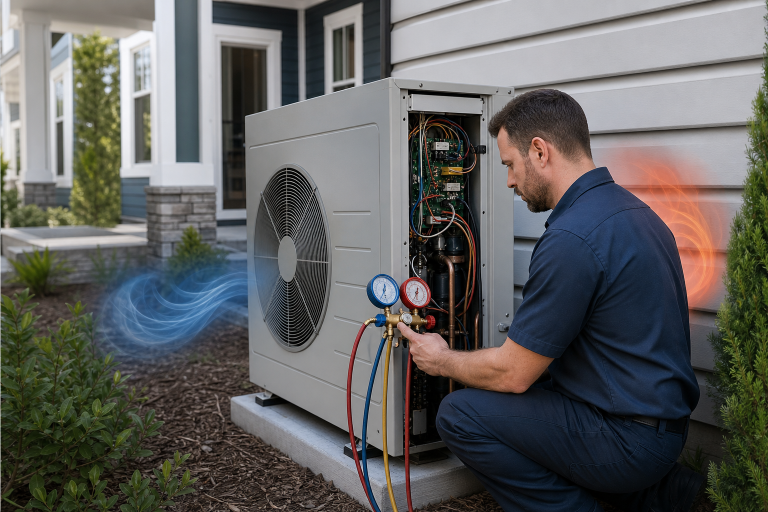
Anyone who maintains, services, repairs, or disposes of equipment that could release regulated refrigerants must hold the appropriate Section 608 certification, according to the EPA’s Section 608 technician certification requirements.
That rule is especially relevant for central air conditioners, heat pumps, and other equipment with refrigerant circuits. Ask the contractor to identify the certified technician who will perform refrigerant-related work. A company license and an individual technician certification are not interchangeable records.
For a complete system replacement, the proposal should say whether refrigerant recovery, removal of old equipment, and commissioning are included. If an estimate is vague about those items, request clarification in writing before comparing it with another quote.
Call for a free estimate:
If one contractor recommends replacement and another recommends repair, compare the diagnosed condition, repair scope, equipment age, warranty status, and expected work required to restore operation. This HVAC repair-or-replace guide can help frame that separate decision.
How should insurance and license records match the contract?
A clear paperwork trail uses the same legal business name across the license record, insurance certificate, proposal, permit application, invoices, and final contract.
Minor variations such as “LLC” versus “L.L.C.” may be harmless, but a substantially different name needs an explanation before you proceed. Ask whether the listed company is a DBA, affiliate, subcontractor, or a separate business. Request the corrected document if the answer is unclear.
The written agreement should describe the equipment, model numbers, labor scope, permits, payment schedule, warranty responsibilities, and process for change orders. Pay close attention to exclusions. A low initial quote may exclude electrical work, crane access, duct repairs, thermostat replacement, condensate work, permits, or disposal. Ask for each exclusion to be priced or acknowledged so competing proposals cover the same job.
What are warning signs in HVAC contractor paperwork?
Pressure to pay before you can review verifiable records is a reason to slow the process down.
Other concerns include a license number that belongs to a different entity, an expired policy date, a certificate with no identifiable issuer, a contract with blank fields, or an estimate that lists only a lump sum without defining the equipment and labor. None of these points alone establishes wrongdoing. Each justifies a direct question and a written answer.
Be cautious if a contractor says permits are unnecessary without identifying the local rule, or if a proposal promises to use another company’s license. Licensing arrangements and permit rules are jurisdiction-specific. The local licensing authority or building department is the right place to confirm them.
A contractor should also be able to give clear contact information for warranty service after installation. Important: Manufacturer parts coverage and contractor labor coverage may be separate, with different terms and claim paths. Read both documents rather than relying on a broad statement that the system is “fully warranted.”
What is the practical verification sequence?
Checking the public license record first, then insurance, then the written scope keeps the process efficient and makes mismatches easier to spot.
- Get a written estimate identifying the legal business name, license number, and proposed work.
- Search the official state license database and confirm status, classification, and any listed restrictions or disciplinary records.
- Confirm local permit requirements with the building department when the project includes replacement, new equipment, fuel-gas work, electrical work, or duct alterations.
- Request a current insurance certificate and verify it through the listed agent or carrier.
- Ask for the applicable EPA Section 608 certification for the person performing refrigerant-related tasks.
- Resolve name differences, scope exclusions, permit responsibility, warranty terms, and payment milestones in the contract before signing.
Verification is a screening step, not a substitute for evaluating the design and scope. Once the records check out, compare written proposals on equipment capacity, efficiency, installation work, warranties, and included corrective work rather than choosing solely by the bottom-line price.
FAQ
Can I verify an HVAC license online?
Usually, the official state contractor licensing agency is the first place to check an HVAC contractor’s license number, legal business name, status, and classification. Local governments may require an additional registration or permit, so confirm requirements with the building department where the work will take place.
Is a certificate of insurance enough?
No, an insurance certificate is useful evidence but does not itself change policy terms or guarantee that a future claim will be covered. Confirm the policy’s active dates and the insured business with the issuing agent or carrier, then make sure the contract uses the same legal name.
Does every HVAC technician need EPA certification?
The EPA requires the appropriate Section 608 certification for technicians who maintain, service, repair, or dispose of equipment that could release regulated refrigerants. Ask the contractor who will perform that work and request confirmation of the applicable credential.
Should I hire a contractor with the lowest estimate if the license and insurance check out?
No, valid credentials establish a baseline, but they do not make different proposals equivalent. Compare the written scope, permit responsibility, equipment details, exclusions, payment terms, startup work, and warranty commitments before deciding.
If the records or contract language remain unclear, request a corrected written proposal or seek another HVAC quote that identifies the licensed entity, coverage evidence, and complete scope in plain terms. For a free, no-obligation discussion please call a listed specialist.