Questions to Ask a Security Installer
A professionally installed security system is a meaningful purchase, but asking the right questions to cover your security concerns is the first step. Tip: Asking focused questions before a walkthrough exposes unclear scope, equipment restrictions, recurring charges, and support gaps while there is still time to compare proposals.
The goal is not to master alarm technology, but to match your concerns with the solutions provided by the installer. At the end of a consultation you should know who will install the system, what will be installed, who controls the equipment, what the service costs over time, and who responds when something stops working.
How can you check an installer’s credentials and experience?
A suitable installer should be able to identify the business entity, the license or registration that applies in the home’s jurisdiction, its insurance coverage, and the people who will perform the work.
- “What license, registration, or permit requirements apply to this work here, and how can I verify your status?” Look for a direct answer that identifies the issuing authority and distinguishes the company’s authorization from an individual technician’s credentials where both apply. A careful company will also explain whether the municipality requires an alarm permit after installation and whether that filing is included in its scope.
- “Can you provide proof of general liability insurance, and does it cover this type of work?” Ask for a current certificate or for the insurer to send verification. The proposal should also say who is responsible for repairing incidental damage to finishes, wiring paths, or equipment affected during the visit. Vague assurances are a poor substitute for written scope and coverage information.
- “Are the people entering my home employees or subcontractors, and what background-screening policy applies?” The useful answer names the employment arrangement and describes the company policy without disclosing anyone’s private personal information. Ask whether the same policy applies to subcontractors and whether a named project contact will be present.
- “How much of your work is similar to this installation?” Ask for relevant experience rather than a broad claim of years in business. A house with detached structures, difficult cable routes, existing smart-home devices, or a need for professional monitoring deserves an installer who can explain comparable project constraints and the proposed approach.
A written estimate should identify the legal business name, contact information, installation scope, and the party providing any monitoring service, especially when installation and monitoring are handled by different businesses. Do not accept pressure to sign before you are comfortable with the provider and have a clear understand of the scope.
What should you ask about the equipment and technology?
The proposal should identify the actual devices, how they communicate, and who controls them after installation. “Smart security system” is a category, not the specifications for a solution. Two packages with similar names may differ in sensors, camera storage, cellular backup, app access, and required subscriptions.
- “Which exact brands and model numbers will you install?” Request a written equipment schedule that separates the control panel, keypad, contacts, motion sensors, cameras, video doorbell, siren, power supply, and any cellular communicator. Model numbers make it possible to read the manufacturer’s current specifications and determine whether a quoted substitute is genuinely equivalent.
- “Will this system work with the smart-home products I already use?” Name the ecosystem, such as Ring or Google Nest, and every device that must remain usable. Ask the installer to explain the specific function that will work, such as shared app access, alerts, voice control, or a simple coexistence of separate systems. “Compatible” can mean very different things, and a verbal promise should be reflected in the proposal.
- “Do I own the hardware, rent it, or receive it under a service agreement?” Look for a plain answer about title, return obligations, replacement charges, and what remains operational if monitoring ends. Ownership of a camera does not necessarily include cloud recording, cellular service, or continuing app features, so ask about each service separately.
- “What happens during an internet or power interruption?” The answer should identify the communication path, any backup battery, whether cellular service is included, and which functions continue under each condition. Do not assume that a Wi-Fi camera and an alarm panel have the same backup capabilities.
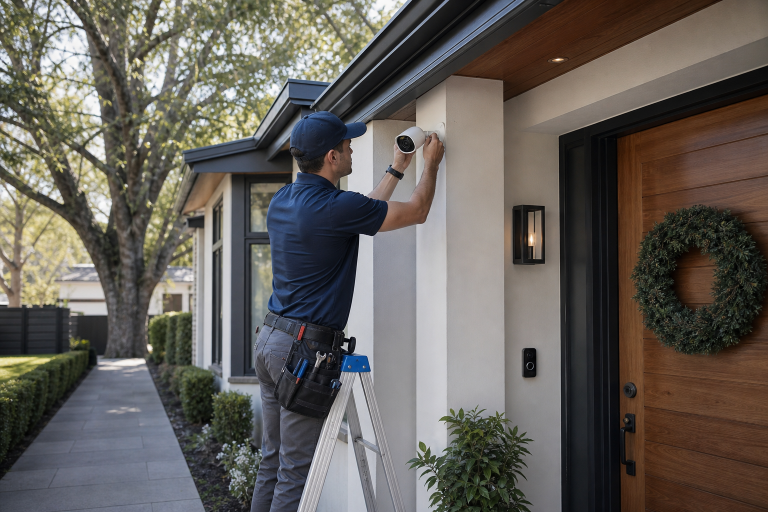
Ask the installer to mark proposed device locations on a floor plan or during the walkthrough, then attach that description to the quote. This is where scope creep often begins: a low initial package may omit a needed door contact, outdoor coverage, electrical outlet, network work, or mounting requirement that appears later as an add-on.
For a useful baseline on camera choices and common cost drivers, see Abodence’s security camera installation cost guide. It is particularly useful when a quote blends equipment, labor, cloud service, and monitoring into one monthly figure.
What must the monitoring agreement say before you sign?
A monitoring agreement should state who receives alarm signals, how service is delivered around the clock, how long the initial commitment lasts, and every charge tied to starting, changing, ending, or moving the service. Professional monitoring is a service contract, not simply an app notification feature.
“Who provides the 24/7 monitoring, and is the central station listed to UL 827?” A direct answer names the monitoring provider and describes its role. UL Solutions’ information on UL 827 central-station alarm services explains that the standard addresses central-station alarm service operations. A UL listing is not a guarantee about every individual response, but asking this question clarifies whether the provider is making a specific, verifiable representation about its monitoring operation.
“What is the initial term, what happens at renewal, and can the monthly rate change?” Ask for the agreement, not only a sales summary, before authorizing installation. The Federal Trade Commission’s consumer guidance on automatic renewals and continuous service offers advises consumers to review recurring-charge terms and cancellation procedures. Confirm the renewal mechanism, notice requirements, and whether equipment financing has a separate term from monitoring.
“Please list every one-time and conditional fee.” The written answer should cover installation, activation, cellular service, service calls, truck rolls, false-alarm administration if applicable, restoration after suspension, equipment returns, transfer, and cancellation. The figure to compare is the total obligation under the stated term, not merely the advertised monthly rate.
“If we move, what choices do we have?” Look for a relocation policy that explains whether the agreement can transfer, whether hardware moves with the homeowner, what installation charges apply at the new address, and what happens if service is unavailable there. An answer of “we will work with you” leaves the key terms unresolved.
Read the cancellation and auto-renewal sections with the same care as the service description. Abodence’s guide to security monitoring contracts explains the terms worth locating before a signature is added.
What warranty and support commitments should be in writing?
A useful warranty separates equipment defects, installation workmanship, monitoring service, and ongoing support because each may have a different provider and remedy. A broad phrase such as “lifetime warranty” has little value until it identifies whose lifetime, which components qualify, what labor is covered, and the exclusions.
- “What is covered by the equipment warranty, and who handles the claim?” Ask for the manufacturer warranty and the installer’s own warranty in writing. Confirm whether replacement labor, shipping, programming, and a temporary device are covered, or whether the homeowner pays even when a component is defective.
- “What workmanship do you guarantee, and for how long?” The answer should address mounting, wire routing, device placement, programming, and repair of installation-caused problems. It should also say how the company documents a service request and whether a diagnostic or dispatch charge applies after the workmanship period.
- “Who do we contact after hours, and what support is available during an alarm or equipment failure?” Request the support phone number, hours, escalation path, and distinction between monitoring assistance and technical service. Monitoring staff may be able to address an alarm event while a separate service department handles a failed camera, sensor, or network connection.
- “Will we receive administrator access, manuals, and a final device list?” Homeowners should know who can add users, change notification settings, and remove access when household circumstances change. A final record of installed devices, serial numbers when appropriate, passwords or transfer procedures, and warranty documents reduces confusion later.
Before approving the work, use one final checklist: the installer’s status is verifiable, the people entering the house are clearly accounted for, every device and location is listed, ownership is explicit, recurring and exit charges are written down, and support responsibilities are assigned. If an answer remains vague, ask for it in the agreement or seek another quote. A consultation should leave room for that decision.
For a system that fits the home and the household’s routines, request a written assessment and compare the answers, not just the package price. For a free, no-obligation discussion please call a listed specialist.
FAQ
Should a security installer provide a written estimate?
Yes, a written estimate gives you a record of equipment, installation labor, device locations, service terms, and exclusions before work starts. It should identify any monitoring provider and separate one-time charges from recurring charges so competing proposals can be compared on the same basis.
Do homeowners own professionally installed security equipment?
Ownership depends on the agreement, and it should never be assumed. Some arrangements sell the equipment to the homeowner, while others tie equipment to rental, financing, or a service plan. Confirm what remains in the home and what functions continue if monitoring is cancelled.
What should a security monitoring contract include?
A complete agreement identifies the monitoring provider, initial term, renewal process, monthly charge, fees, cancellation procedure, and relocation policy. It should also explain what communication service is included and whether a price change is permitted during or after the initial term.
How do you compare two security installation quotes?
Compare the complete scope, not the advertised package label. Match device model numbers, quantities, installation work, ownership terms, monitoring duration, total recurring cost, and warranty coverage. A lower starting price may omit equipment, backup communication, labor, or contract obligations included elsewhere.