Essential Drip Edge Guide: Why Your Roof Needs It
Drip edge is a metal flashing installed along roof edges to direct water away from the fascia and into the gutter, and modern codes treat it as a required part of asphalt shingle roof systems in many cases.

Call for a free estimate:
It is a small component, but it does an important job. When roof edges are left exposed, water can curl back under shingles, soak the roof deck edge, stain trim, and shorten the life of adjacent materials. A properly installed drip edge helps control that runoff path.
For homeowners, the practical question is usually simple: do you need it, and does it matter enough to insist on it in a roofing quote? In most asphalt shingle projects, the answer is yes. The International Residential Code, as published by the International Code Council in Section R905.2.8.5, requires drip edge at eaves and gables for asphalt shingle roofs, with specific overlap and fastening details. Local code adoption can vary, so your jurisdiction may be on a different IRC edition or have amendments, but the direction of modern code is clear.
If you are reviewing a roof proposal, it also helps to understand how edge details affect warranty language. Abodence covers that in roof warranty terms explained.
What is a drip edge on a roof?
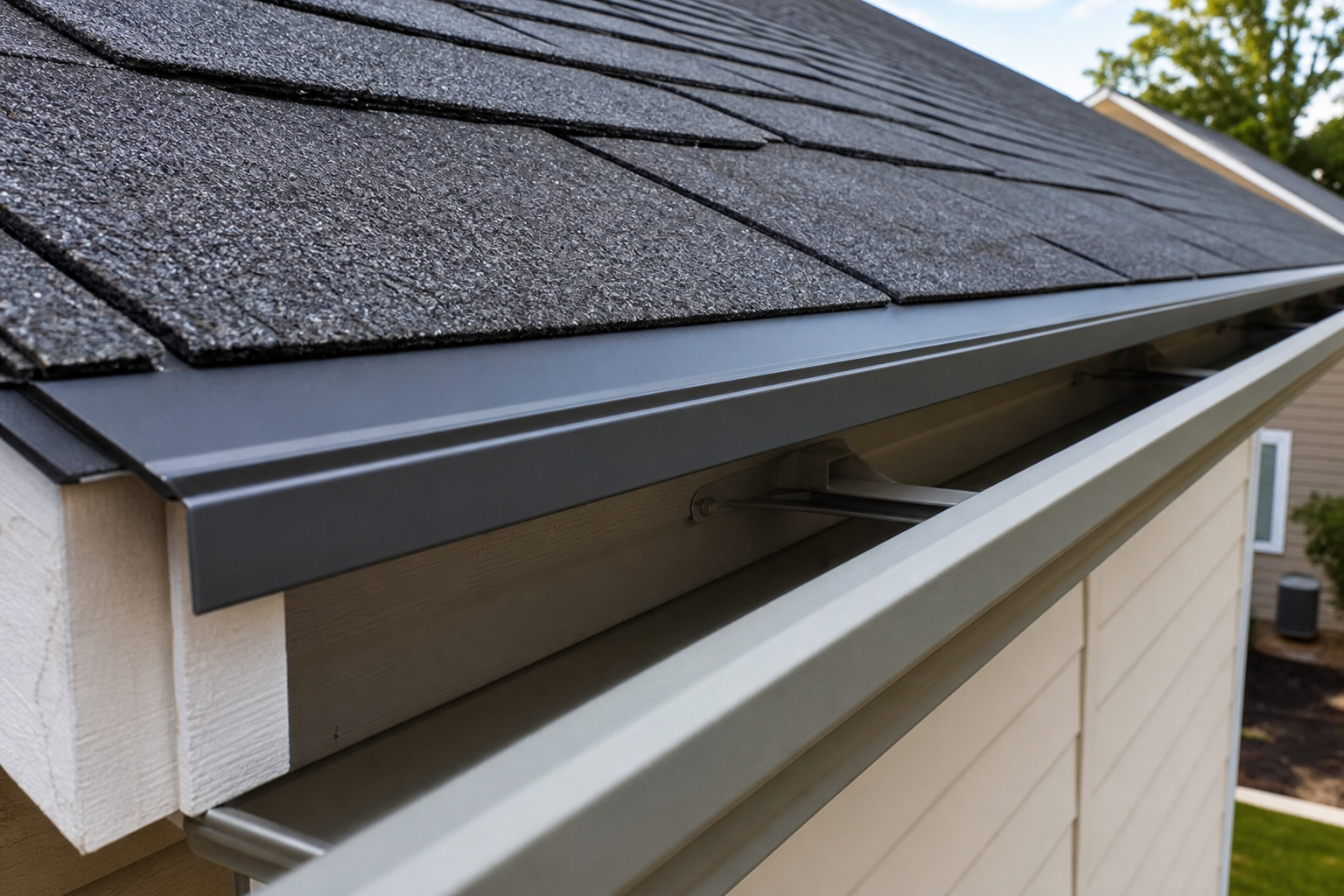
A drip edge is a shaped metal strip that covers the roof deck edge and kicks water away from the fascia board and into the gutter line.
Most drip edge products are made from corrosion-resistant metal such as aluminum, galvanized steel, or copper. The profile usually has a roof flange that sits under the underlayment or shingles at the edge, a vertical face that covers the roof edge, and a small outward bend that helps water drop clear instead of clinging back toward the wood.
The concept is straightforward. Roof runoff follows surfaces. If the edge detail does not break that surface tension, water can wick behind the gutter or against the fascia. The metal edge creates a cleaner exit point.
Manufacturers and trade groups describe drip edge as both a water-management component and an edge-protection detail. The National Roofing Contractors Association Roofing Manual and GAF installation instructions both describe metal drip edge at roof perimeters as part of the standard roof edge assembly for asphalt shingles.
Why is drip edge necessary?
It is necessary because roof edges are one of the easiest places for water intrusion and wind damage to start.
According to the Federal Emergency Management Agency guidance on protecting building openings and edges from wind-driven rain, roof edge details are critical in managing water intrusion and reducing vulnerability at exposed perimeters. In asphalt shingle systems, that same principle applies at the eaves and rakes, where runoff, capillary action, and wind can work against the roof edge.
Drip edge helps in several specific ways:
- It directs water off the roof edge and away from fascia trim.
- It reduces the chance of water getting under the first course of shingles.
- It helps protect the edge of the roof deck from repeated wetting.
- It improves resistance to wind-driven rain at vulnerable roof perimeters.
- It gives the shingle edge firmer support at the perimeter.
Without it, a roof can still look finished from the ground while the edge assembly quietly takes on water during storms.
That is one reason roof edge details deserve to be spelled out in writing, not left as a vague line item.
Where does drip edge go on a roof?
It belongs along the eaves and rake edges, with placement coordinated with underlayment based on the edge location.
For asphalt shingle roofs, code and manufacturer instructions distinguish between the lower horizontal roof edge, called the eave, and the sloped side edges, called rakes or gables. Per the IRC section cited earlier, drip edge must be mechanically fastened to the deck, overlapped at least 2 inches, and extend a specified distance onto the roof deck and below it.
How placement differs at eaves
At the eaves, the metal edge is typically installed under the underlayment so water on top of the underlayment can shed onto the drip edge and then into the gutter path.
That sequencing is reflected in asphalt shingle application instructions from Owens Corning and GAF. It is a detail that matters because reversing the order can create a path for water to reach the deck edge.
How placement differs at rake edges
At rake edges, the metal edge is typically installed over the underlayment so wind-driven water is less likely to get under the edge of the membrane or felt.
This is one of those details that often gets missed in quick explanations. “Install drip edge” is not enough by itself. The edge location changes the layering sequence.
Call for a free estimate:
What problems can happen if a roof has no drip edge?
The most common problems are rotted fascia, stained trim, roof deck edge deterioration, and water running behind gutters instead of into them.
Those failures develop over time. You may first notice peeling paint, swollen wood at the eaves, or dark staining where runoff repeatedly contacts the same area. In colder climates, poor edge drainage can also contribute to ice-related edge issues by letting water linger where it should shed cleanly.
Wind can make the problem worse. The Asphalt Roofing Manufacturers Association residential asphalt roofing manual explains that proper edge metal is part of a complete shingle roof assembly and helps protect perimeter conditions where uplift forces are more severe. Edge zones are exposed zones.
Not every roof without drip edge will show immediate damage. Some older roofs performed acceptably for years with different edge details. But if you are replacing shingles now, relying on an outdated omission rarely makes sense when current code and current manufacturer instructions expect the metal edge to be there.
What materials are used for drip edge?
Most residential drip edge is made from aluminum or galvanized steel, with copper used on some premium or specialty roofs.
The best material for your home depends on the roof system, local climate, and nearby metals. The National Roofing Contractors Association notes in its roofing manuals that metal selection should account for corrosion resistance and compatibility with adjacent materials. For example, mixing certain dissimilar metals can create corrosion problems in the presence of moisture.
For many homes, painted aluminum or galvanized steel is the standard practical choice. Copper is durable and visually distinctive, but it is usually selected for architectural reasons or for roof systems already using copper flashing. More expensive metal is not automatically better if the rest of the roof assembly does not call for it.
How can you tell whether drip edge is installed correctly?
A proper installation shows continuous metal along roof edges, visible overlap between sections, secure fastening, and a profile that projects water clear of the fascia line.
From the ground, you can often see the metal edge as a narrow finished strip beneath the shingles. Up close, the more important checks are about sequence and fit, especially at corners and transitions. A sloppy edge detail can leave gaps, reverse laps, or short sections that do not protect the wood below.
What a written roofing quote should include
A solid proposal should identify the drip edge material, where it will be installed, and whether damaged fascia or roof deck edges are excluded or included.
- Type of metal, such as aluminum or galvanized steel
- Locations covered, eaves only or eaves and rakes
- Whether replacement is new or reuse of existing edge metal
- Coordination with underlayment and ice barrier at eaves
- Any excluded wood repair at fascia or deck edge
Vague proposals create avoidable disputes. “Install new roof” does not tell you whether edge metal is part of the scope.
If you are comparing roofing systems more broadly, roofing materials compared can help you sort out how components and warranty terms change by roof type.
Can drip edge be added to an existing roof?
Sometimes it can be added during a repair, but the cleanest and most reliable time to install it is during a full roof replacement.
Retrofit work depends on how the existing shingles, underlayment, and gutter system are installed. On some roofs, a contractor can carefully lift the first shingle course and insert edge metal. On others, that process can damage brittle shingles or still leave imperfect layering. If the roof is already near the end of its service life, adding drip edge alone may not be the best use of money.
A limited repair can still be reasonable when the rest of the roof is in good shape and the issue is confined to one edge. The practical question is whether the contractor can install the metal without creating a new problem at the shingle edge.
How much does drip edge installation usually cost?
As a small part of a full reroof, drip edge is usually a modest line item, while standalone repair pricing varies more because labor and access drive the job.
Published national cost sources do not always break out drip edge as a separate category with strong methodology, so it should not be presented as a universal per-home figure without a named source. In practice, many reroof quotes include drip edge within the broader roof replacement scope rather than as a separate price. If you need a repair-only quote, ask for the edge metal scope to be itemized so you can compare labor, materials, and any wood repair separately.
For the broader project context, roofing timelines and scope planning often matter more than the isolated cost of one metal trim piece. Abodence covers that in roof replacement timeline.
What questions should you ask a roofer about drip edge?
The best questions focus on code compliance, manufacturer instructions, and whether the quote clearly includes all edge-related work.
Call for a free estimate:
- Will drip edge be installed at both eaves and rake edges?
- Which code edition are you following in this jurisdiction?
- How will underlayment be layered at eaves versus rakes?
- What metal will you use, and is it compatible with the gutters and flashing already on the house?
- Is any fascia or roof deck edge repair included in the quote?
- Will the final invoice and warranty paperwork reflect the installed edge components?
Those questions are useful because they move the conversation from assumptions to documented scope.
FAQ
Does every roof need drip edge?
Most asphalt shingle roofs should have it because current residential code and common manufacturer instructions call for metal edge protection at eaves and rakes. Other roof types use different edge details, so the exact component can vary by system.
Is drip edge the same thing as gutter apron?
No, the two parts are related but not identical. A gutter apron is a specific flashing profile designed to direct water more deeply into the gutter, while drip edge is the broader roof-edge flashing category used at eaves and rake edges.
Can missing drip edge cause leaks?
Yes, missing edge metal can contribute to water intrusion at the roof perimeter by letting runoff reach the deck edge, fascia, or the area behind the gutter. The leak may show up as trim damage first rather than a ceiling stain.
Should drip edge be replaced when shingles are replaced?
In most cases, replacing or at least closely evaluating the edge metal during reroofing is the practical approach. Reusing old metal can make sense only if it is compatible with the new roof system, undamaged, and acceptable under local code and manufacturer instructions.
What color should drip edge be?
The color is mostly a finish choice unless a specific metal is required for compatibility. Many homeowners match it to fascia trim or gutter color so the edge line looks intentional from the ground.
If you are reviewing a roofing proposal and want help making sense of the edge details, warranty language, or scope, please call a listed specialist for a free, no-obligation discussion.
Sources: National Roofing Contractors Association Roofing Manual, GAF Asphalt Shingle Application Instructions, Owens Corning installation instructions, CertainTeed Shingle Applicator’s Manual