Important Questions to Ask a Pest Control Company
A pest problem may need prompt attention and a reputable provider should be able to explain what it found, what it proposes to do, what you need to do before treatment, and what the agreement costs for initial and follow up service.
Start by describing the pest, where you have seen it, when activity occurs, and any prior treatment. Then use the questions below to compare written answers from more than one company. An inspection and a defined scope are more useful than a quick promise to “spray everything.”
What license and insurance should a pest control company have?
The company should identify its state-issued pest control license, the license category that covers the proposed work, and the individual responsible for the treatment.
Pest-control licensing is handled at the state level, so the exact license name, credential requirements, and public lookup process vary by location. Ask for the legal business name shown on the license, the license number, its expiration date, and the state agency that regulates it. Check the number through that agency’s official license search rather than relying only on a card, truck decal, or sales representative’s statement.
Use this as a direct question: “What is your state pest-control license number, which license category covers this treatment, and where can I verify it?” The answer should be specific enough for you to independently confirm. A company that cannot provide it before scheduling deserves further scrutiny.
Also ask, “Who will apply the product, and are they licensed or working under the supervision required by this state?” The point is not to demand a particular job title. It is to establish who is accountable for the work and whether the company can explain its staffing arrangement plainly.
Insurance deserves its own question: “Do you carry general liability insurance, and can you provide a current certificate of insurance?” Ask the insurer or agent named on the certificate how you can confirm the policy remains active. If a treatment is being proposed for a condominium, rental, or homeowners association property, the owner or manager may also have separate requirements for certificates, additional insured status, or notice before access. Professional certifications can add context, but they should not replace a state license.
What should the inspection and written treatment plan include?
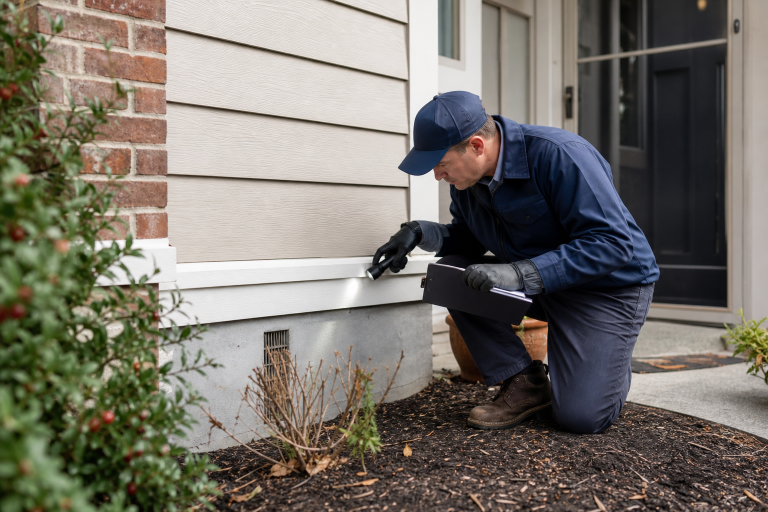
A useful proposal identifies the pest or the evidence found, the places to be treated, the method to be used, and the conditions that could change the scope. Ask, “What did the inspection show, and what evidence supports the pest identification?” Different pests call for different control methods. A company should distinguish between an active issue, a likely entry point, old evidence, and an area it could not inspect. If identification is uncertain, ask what it will do to confirm it before selecting a product or pricing an ongoing program.
Next ask, “What areas will you inspect and treat, and what areas are excluded?” Exterior perimeter work, attic access, crawl spaces, wall voids, garages, bait stations, and indoor rooms are separate parts of a scope. Broad phrases such as “whole-house protection” do not tell you what will actually happen.
Ask whether the plan uses inspection, sanitation recommendations, exclusion work, monitoring, trapping, baiting, or pesticide application, and request an explanation of the order. The U.S. Environmental Protection Agency describes integrated pest management as an approach that uses pest information and available control methods together, with prevention and monitoring among its core practices. EPA’s introduction to integrated pest management is useful context for asking whether a recurring application is necessary or whether sealing an entry point, correcting a moisture condition, or changing storage practices addresses the source of the problem.
A simple, limited service may be enough when the inspection identifies a specific and correctable cause. Do not accept a larger recurring package solely because it is presented as the default option.
Finally, ask, “What can make the price or scope change after service begins?” The written answer should distinguish a fixed-price visit from work billed by time, material, number of stations, linear footage, access difficulty, or repair needs. It should also say whether the technician needs approval before doing additional billable work.
What should you ask about pesticides, pets, children, and preparation?
You should receive the product information, application locations, safety directions, and preparation instructions before treatment starts.
Ask, “What products might you use, what are their active ingredients, and can I have the label and Safety Data Sheet before service?” The product label is a legal use document in the United States. According to the EPA’s pesticide safety guidance, pesticides must be used according to label directions. A provider should be able to tell you whether the plan calls for a spray, bait, dust, trap, or another method, as well as the precise locations where it may be placed.
Ask a separate household-safety question: “What steps are required for children, pets, food items, toys, bedding, and pet bowls before, during, and after treatment?” Do not accept a generic assurance that a product is “safe.” The EPA advises consumers to follow label directions and keep pesticides away from children and pets.
For households with young children or animals, discuss access control in clear terms. Ask where bait stations or traps will be installed, how they will be secured, whether the company will retrieve or inspect them, and what you should do if a device is moved or damaged. For more detail before booking a visit, see this guide to pest-control considerations for pets and children.
How should you evaluate an “eco-friendly” option?
An environmental claim should lead to a description of the method, not a vague assurance about the product.
Ask, “What does eco-friendly mean in this proposal, and what specific tools or products does it include?” It may refer to monitoring, exclusion, traps, reduced-risk products, or a limited-use pesticide plan. Ask what tradeoffs apply, including whether the method needs more follow-up visits, works only for certain pests, or requires changes in how the property is maintained. A clear explanation lets you compare methods without assuming that a marketing term defines safety or results.
Preparation can determine whether a visit proceeds as planned. Ask for written instructions that specify what must be moved, cleaned, covered, laundered, removed, or made accessible, along with the deadline for completing each task. If the company expects you to empty cabinets, clear a pantry, move furniture, or allow access to a crawl space, that belongs in writing before the appointment.
What guarantee and contract terms should be in writing?
A guarantee has value only when the agreement states what triggers a return visit, what the company will do, how long coverage lasts, and what is excluded.
Ask, “If activity continues, is re-treatment included, and what proof or conditions are required?” Some agreements cover a follow-up application while others provide inspection only, charge for each additional visit, or exclude areas that were inaccessible. Get the time period, covered pest, covered locations, appointment process, and any preparation requirements in the contract.
Then ask, “Is this a one-time service, a fixed-term agreement, or an automatically renewing plan?” Request the complete service agreement before signing, including every page referenced by a work order. Confirm the visit frequency, total cost, payment schedule, renewal date, notice deadline, cancellation method, and any fee for early termination.
Pressure often appears in the fine print rather than the treatment description. A low introductory price may apply only to the first visit, while later charges depend on a monthly plan or an annual commitment. Ask, “What will I owe if I cancel before the term ends, and where is that amount stated?” If the answer is not written clearly, pause before authorizing service.
Door-to-door sales deserve additional care. The Federal Trade Commission’s Cooling-Off Rule explains that certain sales made at a consumer’s home may carry cancellation rights, while exceptions and state rules can apply. Ask for a copy of the cancellation notice and read the agreement before signing electronically or on a tablet. A salesperson’s claim that an offer expires today is not a substitute for reviewing the contract.
Which warning signs should make you slow down?
Several sales patterns justify a pause because they prevent you from checking scope, credentials, and contract terms before a signature or money changes hands.
- An uninvited salesperson demands an immediate decision. A legitimate company can provide identifying information and give you time to verify it. A same-day offer does not require same-day acceptance.
- The vehicle, paperwork, or technician cannot clearly identify the legal business. An unbranded vehicle alone does not prove wrongdoing, but it gives you one more reason to verify the license, insurance, physical business address, and written agreement before proceeding.
- A price is quoted without an inspection or without asking what pest is involved. Remote estimates can be appropriate for narrowly defined services, but a provider should explain what information the price assumes and what could change it.
- The proposal promises to eliminate every pest with one product or one visit. Ask for the pest-specific plan, the expected follow-up, and the property conditions that affect results.
- The representative will not leave the label information, preparation instructions, or contract. You need those documents to compare service and meet any household requirements.
- The agreement uses broad language but omits cancellation and renewal terms. Do not rely on a verbal explanation where the written contract is silent or contradictory.
Keep copies of the inspection report, proposal, service agreement, invoices, product records, and messages about follow-up. Those records make it easier to compare promises with completed work and to resolve a billing question without relying on memory.
FAQ
Should a pest control company inspect before quoting a price?
A provider should explain the inspection basis and assumptions behind any quoted price. A flat fee may make sense for a clearly defined visit, but pest identification, access, treatment areas, and follow-up needs can affect the scope. Request a written description of what is included and what would require approval as additional work.
Can you cancel a pest control contract after signing?
Your ability to cancel depends on the agreement, the sales setting, and applicable law. Review the cancellation clause before signing, especially for a home-solicited sale. The FTC’s Cooling-Off Rule may apply to certain transactions, but exceptions and state requirements mean you should read the notice supplied with the contract.
What should you do before a pest control treatment?
Follow the company’s written, product-specific preparation directions and ask for clarification before the technician arrives. Confirm access needs, food and pet-item handling, cleaning instructions, and any reentry directions. Preparation should match the actual treatment plan rather than a generic checklist.
Is recurring pest control always necessary?
No, the appropriate service schedule depends on the pest, inspection findings, property conditions, and the control method proposed. For a limited issue, a one-time treatment plus exclusion or sanitation changes may fit the documented scope. Ask the company to explain why its recommended frequency is necessary.
Once you have comparable written plans, contact a licensed local provider for a quote that identifies the pest, treatment scope, preparation requirements, and contract terms. For a free, no-obligation discussion please call a listed specialist.